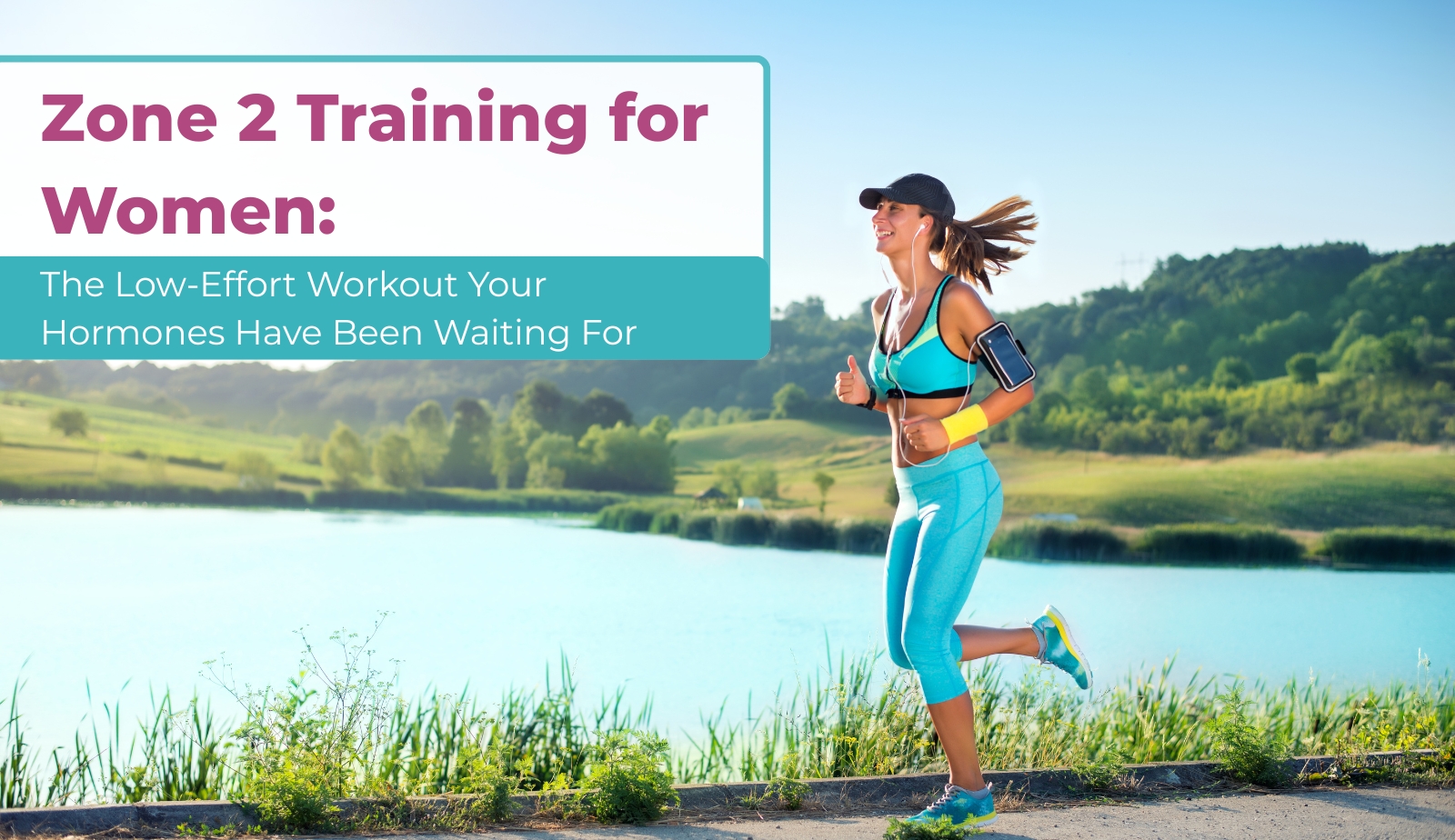





Zone 2 training — exercising at a sustainable, conversational pace — is one of the most powerful tools available for women’s hormonal health, mitochondrial function, and long-term energy. Unlike high-intensity training, Zone 2 keeps cortisol low, strengthens the body’s cellular energy system, and aligns with what Traditional Chinese Medicine has described as optimal movement for thousands of years: warming without consuming.
What Is Zone 2 Training?
Zone 2 training means exercising at an intensity where you can hold a full conversation without gasping — think brisk walking, easy cycling, a relaxed swim, or a light jog. It corresponds to approximately 60–70% of your maximum heart rate, and if you wanted to measure it precisely, blood lactate levels stay at or below 2 mmol/L.
At this intensity, your mitochondria — the energy-producing structures inside every cell — are doing the primary work. You’re in aerobic metabolism: efficient, fat-burning, and sustainable. This is the zone where cellular adaptation happens quietly but powerfully, without triggering the stress response that higher-intensity exercise produces.
Why Zone 2 Training Matters More for Women Than Men
For women, exercise intensity is a hormonal conversation. And Zone 2 speaks the right language.
In Traditional Chinese Medicine, the Heart governs the *shen* — the spirit, consciousness, and emotional equilibrium that shapes how we feel from the inside out. The classical texts described ideal physical exertion as movement that “warms without burning”: effort that builds Qi without depleting it. This wasn’t poetic language — it was clinical observation, accumulated over centuries, about what sustained vitality actually requires.
Modern endocrinology confirms it. High-intensity training, when it dominates a woman’s exercise routine without adequate recovery, chronically elevates cortisol. And cortisol, at sustained high levels, competes with progesterone for the same receptor pathways — suppressing the calming, cycle-regulating hormone that so many women are already running low on. The result: disrupted sleep, worsened PMS, irregular cycles, and the kind of exhausted-but-wired feeling that’s become normalized in women who “push through.”
Zone 2 keeps cortisol low and stable. It challenges the cardiovascular and metabolic system without triggering a sustained stress response — which makes it uniquely suited to the hormonal landscape of women, particularly during perimenopause, postpartum recovery, or any period of elevated life stress.
How Zone 2 Training Strengthens Mitochondria
Mitochondria are the energy factories inside every cell — your heart, muscles, brain, adrenal glands, and ovaries are all densely packed with them. When mitochondria are healthy, energy production is efficient, recovery is fast, hormones are better supported, and inflammation stays low. When mitochondrial function declines — as it does with age, chronic stress, or metabolic dysfunction — everything downstream suffers.
Zone 2 training is the primary stimulus for mitochondrial adaptation. At this intensity, you’re pushing your aerobic system to its productive edge: challenging enough to signal growth, not so hard that you trigger breakdown. Over weeks and months of consistent Zone 2 work, mitochondria multiply, become more efficient, and develop greater capacity to burn both glucose and fat as fuel.
In TCM, this maps to nourishing the *Kidney Jing* — the foundational essence that governs longevity, reproductive vitality, and physical resilience. Zone 2 doesn’t spend this essence. It deepens it.
The 80/20 Principle of Training for Women
Research on elite endurance athletes — and an expanding body of evidence on recreational fitness — consistently supports a training distribution of approximately 80% Zone 2, 20% higher-intensity work.
For women managing hormonal health alongside fitness goals, this ratio is not just effective — it’s protective. The majority of time spent in low-cortisol, high-mitochondrial stimulus training builds a foundation that higher-intensity sessions can then sharpen. Flipping the ratio — training hard most days — is a common pattern in women who feel stuck: their performance plateaus, recovery worsens, and hormonal symptoms amplify, because the foundation has been bypassed.
The ancient Chinese principle of *wu wei* — effortless action that achieves maximum effect — describes Zone 2 precisely. It looks unhurried. It doesn’t feel dramatic. And it is doing something that no amount of harder effort can substitute: rebuilding the cellular engine that powers everything.
How to Find Your Zone 2
You don’t need a heart rate monitor to start. The conversational test is reliable: if you can speak a full sentence without catching your breath, you’re likely in Zone 2. If you’re breathing hard between phrases, you’ve gone above it.
Most women who “jog” are actually working above Zone 2. You may need to slow to a brisk walk — or even an easy walk — to stay in range. That adjustment is often humbling at first. It shouldn’t be. You are training the system that sustains you for decades.
Start with 30–45 minutes, three to four times per week. As your mitochondria adapt, you’ll notice the same pace feels easier at the same heart rate. That’s the adaptation working. That’s the furnace getting stronger.
At Karviva, sustainable nourishment is our foundation — in food and in movement. Zone 2 is the movement expression of that same principle: steady, intelligent, deeply restorative. Strategic effort, not maximum effort. Ancient wisdom confirmed by every lab study that has measured it.