





You cancelled the dinner. You skipped the workout. You spent Sunday on the couch protecting your energy. And on Monday you woke up more exhausted than the week you were busy.
If that sounds familiar, you are not doing rest wrong. You are running into something older than any wellness trend — a rhythm that Traditional Chinese Medicine described centuries ago and that modern research keeps confirming: energy that is never spent becomes harder to restore.
The Battery That Was Never Discharged
I heard a TCM physician describe this recently in a way that stuck with me. A lithium battery that sits unused doesn’t stay full — it slowly degrades. Leave it in a drawer for a year and it holds less charge than the one you used every day.
Bodies behave the same way. And most of us have the model backwards. We treat energy like a savings account: spend less, keep more. But the body treats energy like a muscle. What you don’t ask for, it stops making available.
The Yin-Yang Rhythm Behind It
In TCM, the day has two halves with two different jobs.
Yang is the outward, active phase — daytime. It’s function expressed: moving, working, thinking, speaking, engaging. Yin is the inward, receptive phase — nighttime. It’s storage and repair: sleeping, digesting, rebuilding.
The two are not opposites competing for the same pie. They generate each other. Yang activity during the day creates the demand that yin fulfills at night. Without meaningful output, the body has little to repair and little reason to descend into deep rest.
This is why the most “energy-efficient” life is so often the one that sleeps the worst. Very little movement, very little challenge, very little demand — and then, at 11pm, a body that isn’t tired enough to go under, and a mind that won’t quiet.
It’s also why the answer to fatigue is so counterintuitive. When you feel depleted, the instinct is to withdraw. But withdrawal deepens the exact pattern that created the depletion.
What the Research Shows
This isn’t only philosophy.
Movement generates energy, even in people who feel they have none. In a randomized controlled trial at the University of Georgia, sedentary adults with persistent fatigue were assigned to six weeks of low-intensity exercise, moderate-intensity exercise, or nothing. Both exercise groups reported meaningfully more energy than the control group. More striking: for fatigue symptoms specifically, the low-intensity group did better than the moderate one — and the improvements happened independently of any gains in aerobic fitness. The benefit wasn’t from getting fitter. It came from moving at all. A 2022 meta-analysis pooling 81 randomized trials and just over 7,000 participants found the same pattern at scale: exercise training reduced fatigue and increased both energy and vitality.
Sitting more tracks with sleeping worse. A 2025 study of middle-aged and older adults found that six or more hours of daily sedentary time was associated with substantially higher odds of moderate insomnia, while higher physical activity levels were associated with lower odds. It’s cross-sectional, so it shows association rather than cause — but it maps precisely onto what yin-yang theory would predict.
Disuse is a signal, and the body listens. In a 60-day bed rest trial, the control group — healthy adults, simply inactive — lost about 5% of leg lean mass, up to 2.6% of tibial bone mineral content and density, 29% of peak oxygen uptake, and as much as 40% of maximal knee extension strength. A second group did short bouts of jump training during the same two months and showed no significant losses at all. Bone follows the same logic — the mechanostat principle, first proposed by Harold Frost in 1987, holds that bone maintains only the strength that mechanical loading tells it to maintain. Carry things, and your skeleton keeps investing. Stop, and it quietly divests.
Across muscle, bone, sleep, and mood, biology keeps saying the same thing: use is the instruction to maintain.
Not All Output Costs the Same
Here’s the nuance that makes this livable: two people can spend identical hours and end up in opposite states.
The difference is often flow. When you’re absorbed in something you actually care about — the kind of work where you look up and two hours have vanished — the physiological cost is very different from the same two hours spent watching a clock. The TCM physician I mentioned described tracking his own days and finding that hours of engaged, enjoyed work sometimes registered as recovery on his wearable, while an hour of high-stakes public speaking cost him more than a five-kilometer run.
Those are one person’s observations, not clinical data. But the principle is well supported: cognitive and emotional labor are real physiological expenditures, and resentment is metabolically expensive in a way that engagement is not.
So the goal isn’t to do more indiscriminately. It’s to spend energy on things you’d choose — and to stop spending it on obligations that only look like rest, like the drink that promises to help you unwind, or the long heavy dinner that leaves your digestion working past midnight.
The Rhythm to Aim For
Health is not a flat line. A healthy day has amplitude: real output, then real recovery.
- Discharge on purpose. Move daily, and don’t wait to feel energetic first — the energy follows the movement, not the other way around. Low intensity counts. A brisk walk counts.
- Load your body. Carry the groceries. Take the stairs. Your bones need the message.
- Choose your spending. Protect your energy from meaningless meetings and obligations, not from the things that light you up.
- Let the low points be low. Feeling wrung out after a demanding day isn’t a malfunction. You spent something. That’s what it feels like.
- Protect the recharge. Finish eating earlier, keep dinner lighter — stopping at about 70% full is the old rule for a reason — and be honest about whether a glass of wine before bed is helping you sleep or just switching you off.
That last one matters more than most people realize, and it’s where we’re heading in Part 2 of this series.
Where Karviva Fits In
There’s an obvious catch in all of this: you can’t spend energy you never made. Discharge only works when the recharge has something to work with.
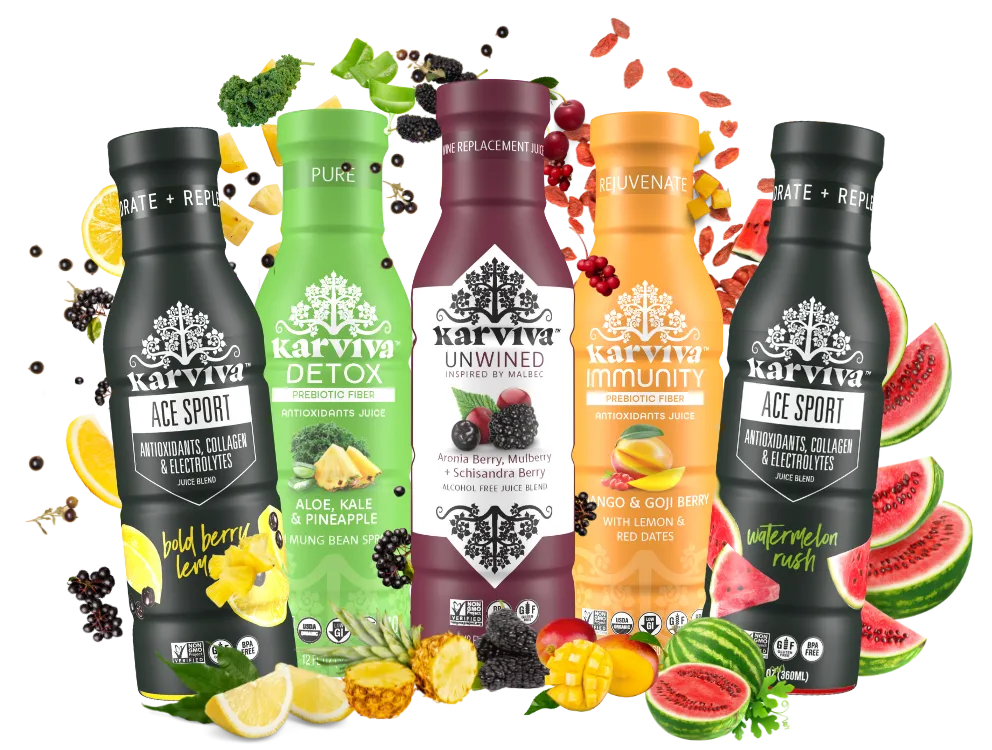
That’s the thinking behind everything we formulate. The Karviva Wellness Reset is built on strategic nourishment, not deprivation — whole-plant blends that keep the fiber in, with only 5–8 grams of naturally occurring sugar per serving and no added sugar, so you get steady fuel instead of the spike-and-crash cycle that leaves you reaching for another coffee at 3pm.
We also formulate with adaptogens that TCM has used for exactly this rhythm — ginseng and ashitaba to support daytime vitality, schisandra and goji berry for the yin side of the cycle, holy basil for the stress load in between. Not stimulants that borrow tomorrow’s energy. Ingredients chosen to support a body that both spends well and restores well.
Rest is not the opposite of energy. It’s the second half of a cycle that only works if you complete the first half.