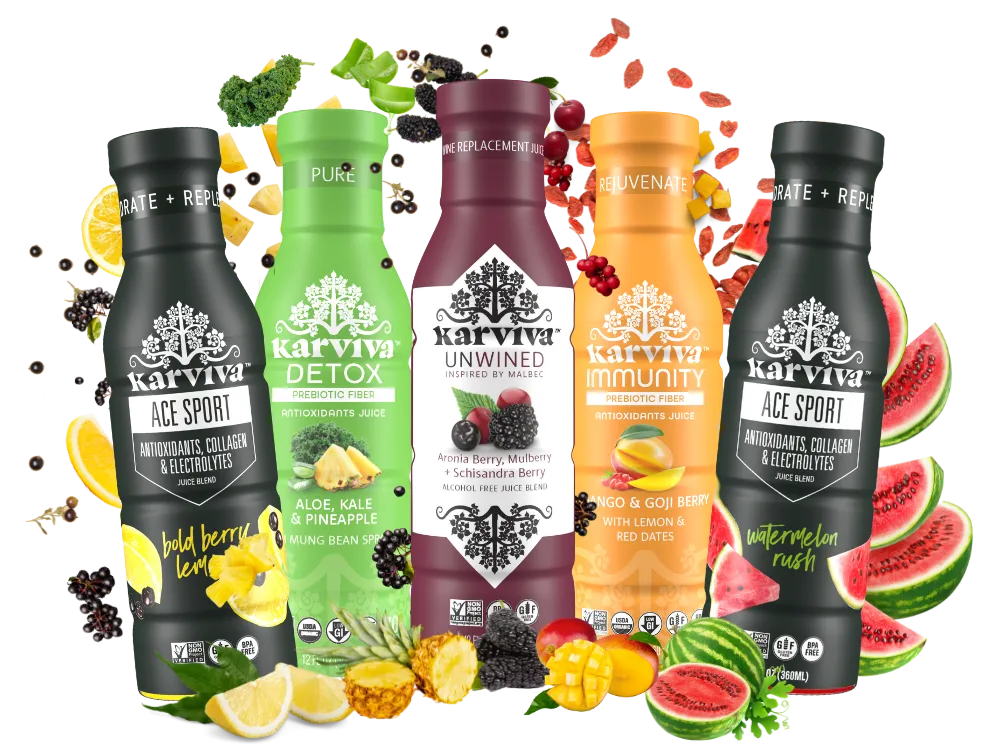
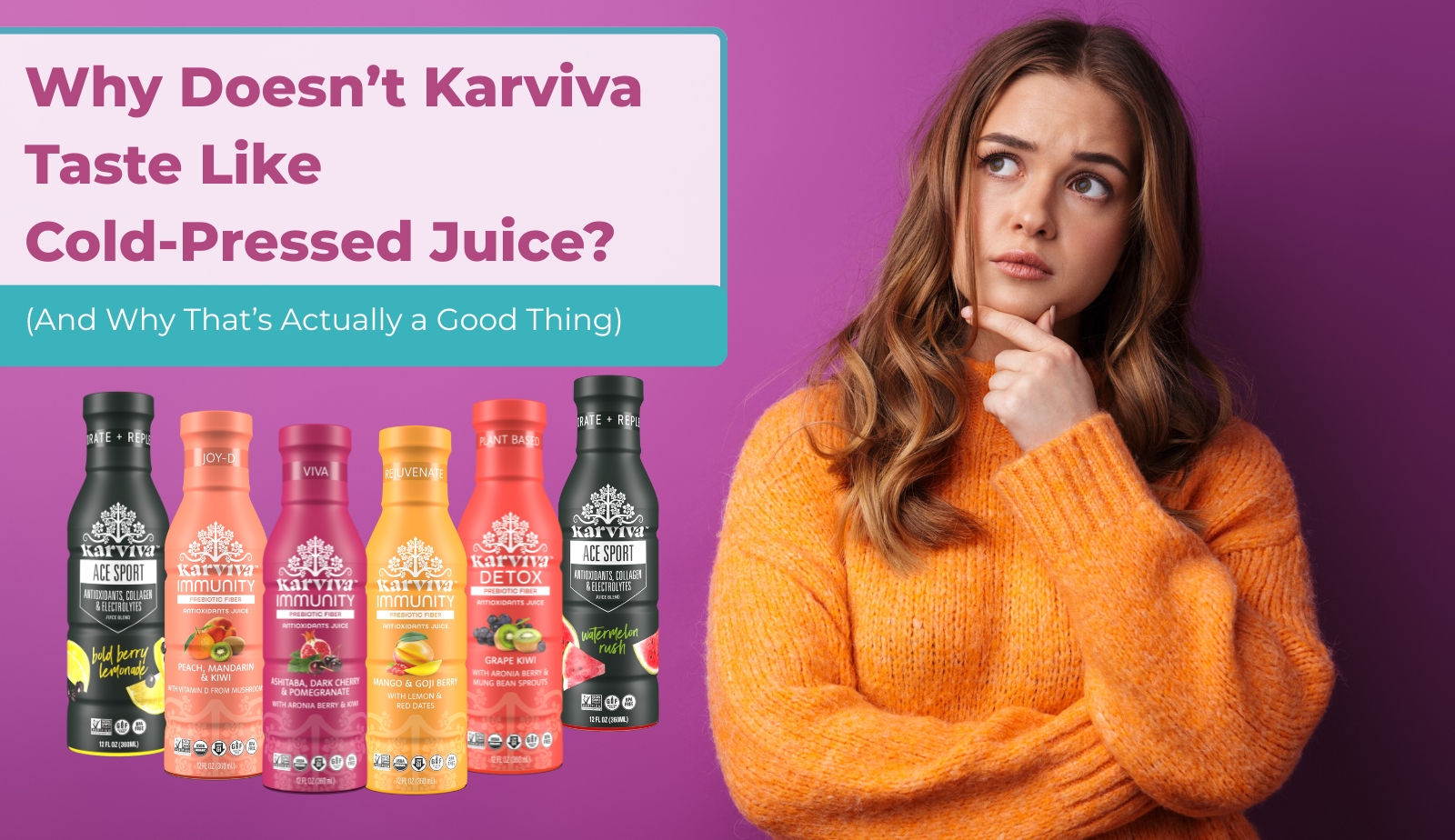





Let me be completely honest with you.
If you’re expecting Karviva to taste like the cold‑pressed juice from your favorite juice bar—candy‑sweet, fruity, and smoothie‑like—you’re probably going to be disappointed at first.
One of our Amazon reviewers put it bluntly: “I didn’t like it. I prefer cold‑pressed juices that come frozen. They taste so much better.”
She’s right about one thing: most cold‑pressed juices do taste “better.” They’re sweet, smooth, and very easy to drink. Karviva tastes more earthy and herbal.
But that difference isn’t a mistake. It’s the visible (and drinkable) proof that we’re doing something fundamentally different—something that actually supports your gut health instead of quietly working against it.
Let me explain.
The Question I Hear All the Time
I hear variations of the same thing over and over:
- “Angela, why doesn’t Karviva taste like the cold‑pressed juice I’m used to?”
- “Why is it so earthy?”
- “Can’t you just make it sweeter?”
I get why you ask. For years, we’ve been trained to think that “healthy juice” should taste like a fruit smoothie—naturally sweet, very fruity, and almost dessert‑like.
So when you drink Karviva and taste ashitaba, ginger, holy basil, sprouts, and other adaptogenic herbs instead of mango and pineapple, your first reaction might be, “This doesn’t taste right.”
But here’s the uncomfortable truth: your taste buds are not always an accurate guide to what’s actually healthy.
Why Cold‑Pressed Juice Tastes So “Good”
Let’s start with why cold‑pressed juice is so likable.
The secret ingredient? Sugar. A lot of it.
A typical cold‑pressed juice often contains:
- Around 30–50 grams of sugar per serving
- Mostly fruit (apple, orange, mango, pineapple)
- Just a little spinach or kale for color
- No fiber—because that’s literally what juicing removes
Why it tastes good:
- Fruit sugar hits your tongue instantly.
- No fiber means ultra‑smooth texture, no “earthy” thickness.
- Sweetness is concentrated because nothing slows it down.
- It goes down like a treat, not like medicine.
Why your brain loves it:
- Sugar drives a dopamine response—your brain lights up.
- It feels indulgent and healthy (“It’s green! It’s juice!”).
- It hits the same reward circuits as dessert, just with a halo.
There’s just one problem: that “delicious” juice, when used as a cleanse or in large amounts, can seriously disrupt your microbiome.
Why This Happens: Sugar, Fiber, and Speed
The study echoes what microbiome research has been saying for a while now:
- Fiber is the primary fuel for beneficial gut bacteria. When you remove it, you starve the microbes that protect your gut lining and help regulate metabolism.
- High sugar with no fiber feeds sugar‑loving, pro‑inflammatory bacteria that thrive on quick, easy energy.
- The microbiome can respond to dietary shifts within 24 hours—so three juice‑only days is enough to create measurable changes.
Bottom line: a juice that tastes like liquid fruit candy is great for your taste buds and often terrible for your microbial balance when used as a cleanse.
Why Karviva Tastes Different (On Purpose)
Now, let’s talk about Karviva—and why it tastes the way it does.
1. We Blend. We Don’t Just Juice.
Cold‑pressed juice:
- Extracts liquid and discards most or all fiber
- Concentrates sugar per sip
- Gives you a smooth, sweet drink that your microbiome doesn’t love
Karviva:
- Uses whole‑plant, blended formulations with fiber and prebiotic components intact
- Keeps sugar low because fiber, sprouts, herbs, and vegetables are doing the heavy lifting
- Naturally has a thicker, more earthy mouthfeel
This aligns directly with Northwestern’s own takeaway: if you love juice, blend instead of juicing to keep fiber, or pair juice with whole foods to protect your microbiome.
We were doing this years before the study, but it’s gratifying to see the science catching up.
2. We’re Herb‑Forward, Not Fruit‑Forward
Cold‑pressed juices are usually built like this:
- Main ingredients: apple, orange, mango, pineapple
- A token handful of greens “for health”
- 30–50 g of sugar per bottle
- Flavor profile: sweet, fruity, refreshing
Karviva flips that:
- Primary focus: adaptogenic and functional herbs like goji berry, schisandra, ginseng, holy basil, ashitaba, and aloe vera
- Real vegetables: kale, cucumber, barley grass, mung and broccoli sprouts—nutrient‑dense, naturally lower in sugar
- Fruit: small amounts, used for balance—not as the main act
- Sugar: usually 5–8 g per serving, with 0 g added sugar
- Flavor: earthy, herbal, sometimes slightly bitter or warming
If we made Karviva taste like a mango‑pineapple smoothie, it would mean we took the herbs out and pushed the sugar up. That would make it easier to sell—but worse for your gut and your blood sugar.
What You’re Actually Tasting in Karviva
When you sip Karviva, your tongue is meeting real plant medicine:
- Goji berry – gently sweet‑tart, earthy
- Schisandra – famously “five‑flavored”: salty, sweet, sour, bitter, and pungent all at once
- Ginseng – earthy, slightly bitter, warming
- Holy basil (tulsi) – peppery, clove‑like, aromatic
- Ashitaba – green, mineral, mildly bitter
- Ginger – spicy, warming, circulatory
- Turmeric – earthy, slightly bitter, grounding
These aren’t “flavorings.” They’re functional doses of botanicals that have been used for centuries to support stress resilience, liver function, circulation, and inflammation response—and are now backed by modern research.
If Karviva tasted like juice‑bar candy, it would probably mean the herbs were there more for the label than for you.
Here’s the question at the heart of all this:
Do you want something that tastes like a treat going down—or something that actually supports your gut, hormones, and metabolism over time?
Because with traditional cold‑pressed, fruit‑heavy, fiber‑free juice, the Northwestern data suggests you often can’t have both.
What “delicious” cold‑pressed juice tends to do (when overused or used as a cleanse):
- ✓ Tastes amazing
- ✓ Feels like a reward
- ✗ Increases bacteria linked to inflammation and gut permeability
- ✗ Reduces beneficial oral and gut bacteria
- ✗ Spikes blood sugar and insulin
- ✗ Leaves you hungry faster (no fiber, no protein)
What Karviva is designed to do:
- △ Tastes earthy and herbal (an acquired taste for some)
- △ Doesn’t feel like dessert
- ✓ Keeps fiber and prebiotic components intact
- ✓ Stays low in sugar
- ✓ Delivers adaptogens and phytonutrients that support stress, hormones, and inflammation
- ✓ Helps you feel more satisfied and nourished, not just “full of juice”
Your taste buds may initially prefer the former. Your microbiome clearly prefers the latter.
“But I Really Don’t Like the Taste…”
This is valid. Not everyone falls in love with Karviva on the first sip. Here’s how I coach people through it:
Give It 3–5 Days
What many people notice:
- Day 1–2: “This tastes weird.”
- Day 3–4: “I’m starting to get used to it.”
- Day 5+: “I kind of like this now—and I feel better.”
Why? Because your taste buds and brain are recalibrating. When you take a break from high sugar, subtle flavors come forward again. Herbs start tasting like what they are—complex and interesting—instead of “strange.”
Gentle Ways to Make It More Enjoyable (Without Breaking the Formula)
You can:
- Add a squeeze of lemon or lime (brightens the flavor)
- Pour it over ice and drink it very cold (temp softens earthiness)
- Blend with a small handful of berries or a bit of cucumber (keeps sugar reasonable)
- Pair it with a few nuts or seeds (smooths the experience and supports satiety)
We don’t recommend:
- Adding fruit juice, honey, syrups, or sweeteners—those undo the low‑sugar, microbiome‑friendly design we worked so hard for.
Most importantly, pay attention to how you feel, not just how the drink tastes:
- Are energy crashes less intense?
- Is brain fog clearing?
- Is digestion calmer, with less bloating?
- Are sugar cravings easing up?
- Is sleep more restful?
Those shifts tell you far more than your taste buds alone.
Taste Buds vs Gut Bacteria: Who Are You Going to Trust?
From an evolutionary standpoint, your tongue is wired to love sugar and easy calories—because historically, those meant survival. Sweet usually equaled safe energy.
Your gut bacteria, on the other hand, thrive on:
- Fiber
- Plant diversity
- Complex polyphenols and bitters
They want exactly the kinds of things that don’t taste like candy.
Most modern food and beverage companies design products to please your tongue first, even in the “health” category. We chose a different path.
At Karviva, we made a clear decision: formulate for your gut, not your sugar addiction.
That means:
- Some people will try Karviva once and go back to cold‑pressed juice, and that’s okay.
- We are here for the people who care more about what a drink does after it’s swallowed than how much it tastes like dessert.
If you’re someone who:
- Prioritizes gut health over flavor alone
- Wants evidence‑aligned formulations, not just pretty labels
- Is willing to retrain your taste toward what actually supports you
then yes—Karviva is probably your kind of “different.”
Learn More & Next Steps
- Read the research:
- Go deeper with Karviva’s philosophy:
- What Exactly Is a Cleanse?
- Why Karviva’s Wellness Reset Is Different from Traditional Juice Cleanses
- The Truth About Fruit During Menopause (And Why Your Hormones Need Strategic Nutrition)
- Try it for yourself:
- Shop Karviva wellness beverages and the Wellness Reset program.
- Download the free 3‑Pillar Menopause Nutrition Cheat Sheet if you’re navigating hormonal changes.