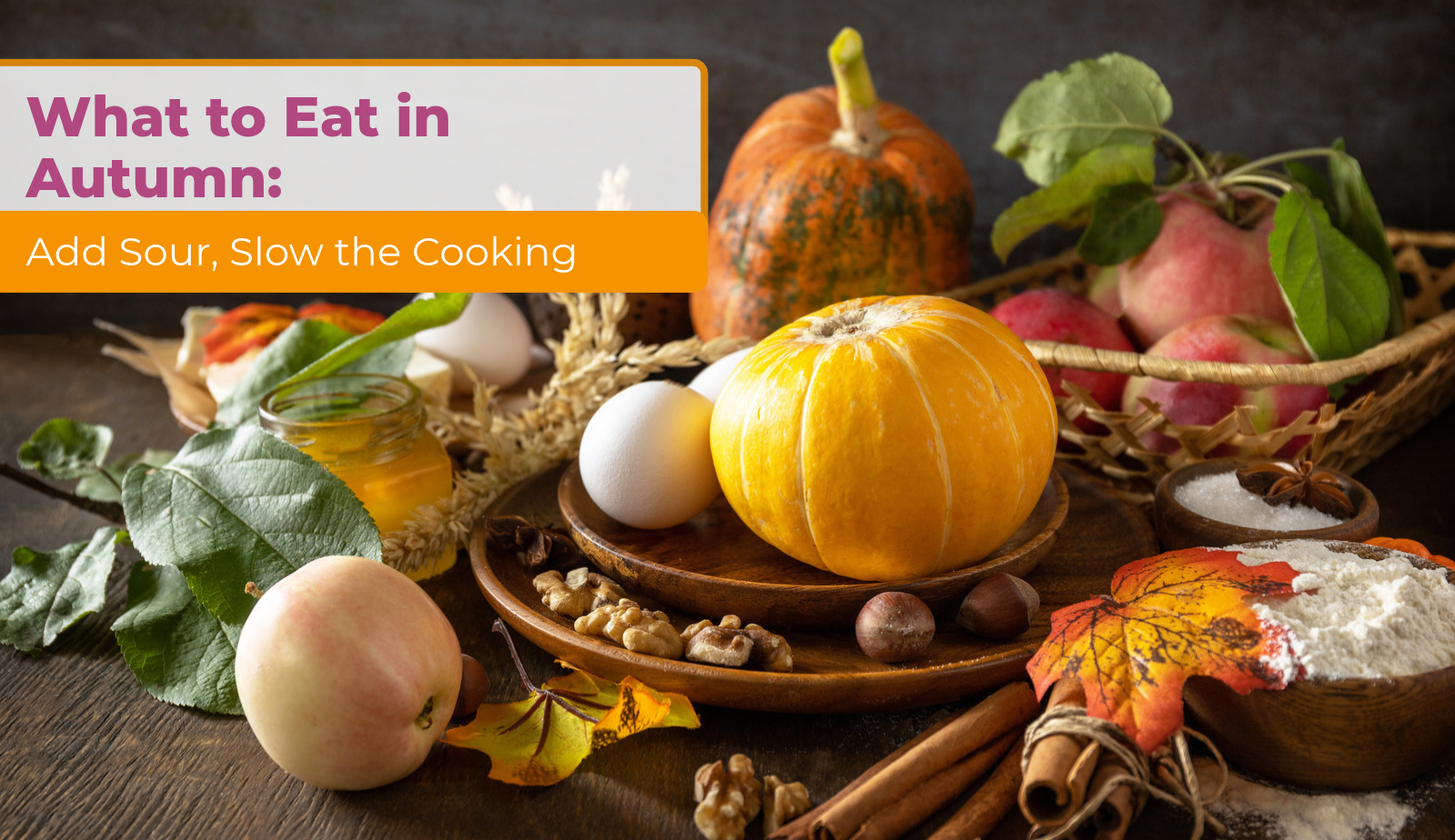





Walk through a Chinese kitchen in autumn and you will notice the change before anyone explains it. The quick summer dishes disappear. A clay pot comes down from the shelf. And something sour starts showing up at every meal: pickled mustard greens, a dish of black vinegar, a bowl of plums.
That habit follows a rule more than a thousand years old. Chinese medicine treats autumn as the season when energy turns inward. The food changes to match: more sour, less strong spice, longer and slower cooking.
This series looks at autumn through the lens of the Lung system, which Chinese medicine assigns to this season. Part 1 is the kitchen. Part 2 is the dryness that arrives with the season. Part 3 is the emotion the tradition ties to it, which is grief.
I will give you the tradition as it is written, tell you where the rules actually come from, and point out where modern nutrition agrees, where it is silent, and where you should be careful.
Autumn Is the Season of Gathering In
In Chinese medicine, the five phases (五行, wǔ xíng) map onto the seasons. Autumn belongs to Metal (金, jīn), and its organ system is the Lung and Large Intestine.
The idea behind Metal is contraction. Sap draws down from the branches toward the roots. Leaves curl and fall. Animals look for shelter. Farmers bring in the harvest and store it. Summer was about growth pushing up and out. Autumn is about gathering in and holding on to what is worth keeping.
The foundational text for this is Su Wen chapter 2, 《四气调神大论》, which gives a short instruction for each season. For autumn it says:
秋三月,此谓容平……早卧早起,与鸡俱兴,使志安宁……收敛神气……此秋气之应,养收之道也。
The three months of autumn are called “settling into form.” Go to bed early and rise early, up with the rooster. Keep the mind calm. Gather in the spirit. This is how one responds to autumn: the way of nourishing what is gathered in.
The key word is 收 (shōu), to gather, to collect, to draw in. Every food rule for autumn in this tradition follows from that one word.
The same chapter adds a warning: 逆之则伤肺,冬为飧泄. Go against this, and you injure the Lung, and in winter you will have loose, undigested stools. In other words, the tradition believed that how you eat and live in autumn shows up one season later. That is a useful way to think about seasonal eating. It is not a quick fix. It is preparation.
Why Sour? Two Classical Sources Agree
The five flavours in Chinese dietary therapy are not just tastes. Each one is said to move energy in a direction. Su Wen chapter 22 puts it in five words: 辛散,酸收,甘缓,苦坚,咸软. Pungent disperses, sour gathers, sweet relaxes, bitter firms, salty softens.
| Flavour | Direction | Autumn advice |
| Sour (酸) | Inward, gathering | Increase |
| Pungent (辛) | Up and out, dispersing | Reduce strong spice |
| Sweet (甘) | Up and out, relaxing | Reduce strong sweets |
| Bitter (苦) | Downward, drying | Keep in balance |
| Salty (咸) | Downward, softening | Keep in balance |
If autumn is about gathering in, sour is the flavour that does the same thing. That is the first line of reasoning.
The second comes from the same chapter, which speaks about the Lung directly: 肺欲收,急食酸以收之,用酸补之,辛泻之. The Lung wants to gather. Eat sour to help it gather. Sour supplements the Lung; pungent drains it.
The most famous seasonal rule comes several centuries later, from the Tang physician Sun Simiao (孙思邈) in his Qianjin Yaofang (《备急千金要方》):
秋七十二日,省辛增酸,以养肝气。
For the seventy-two days of autumn, reduce pungent and increase sour, to nourish the Liver qi.
This one surprises people, because it names the Liver, not the Lung. The logic is five-phase logic. In autumn, Metal is at its strongest, and Metal is said to restrain Wood, which is the Liver. Sour is the Liver’s own flavour. So adding sour in autumn protects the Liver from being overpowered, while cutting back on pungent avoids feeding a Metal that is already strong.
So you have two routes, one from the Neijing and one from Sun Simiao, and both land in the same place: in autumn, a little more sour and a little less strong spice. That is as close to a consensus as seasonal eating in this tradition gets.
One practical point that matters: this is season first, person second only when you are healthy. When someone is unwell, the tradition reverses the order. A person with a chest full of thick phlegm, for example, may need pungent foods to move it before sour foods are appropriate, because sour gathers and can hold phlegm in. The seasonal rule is for maintaining balance, not for treating a condition.
What “Sour” Looks Like on a Real Plate
The good news is that autumn delivers sour foods on its own. Harvest season is full of them.
- Fruit: plums, apples, grapes, cranberries, hawthorn (山楂, shān zhā), pomegranate, citrus as it comes into season
- Vinegars: rice vinegar, black vinegar (香醋), apple cider vinegar, a splash in soups and dressings
- Fermented and pickled vegetables: sauerkraut, kimchi, pickled mustard greens (酸菜), naturally fermented pickles
- Fermented dairy, if you tolerate it: yogurt, kefir
You do not need to eat these on their own or in large amounts. The traditional idea of a balanced meal includes all five flavours. Autumn simply turns up the sour a little. A spoon of pickles beside rice, vinegar in a soup, a baked apple after dinner. That is enough.
Where the Science Meets the Sour
Here is where it gets interesting, because the most useful sour foods of autumn happen to be the ones modern nutrition research has been paying attention to.
Fermented foods and the gut. In 2021, a Stanford team published a randomised trial in Cell that I find myself citing often. Thirty-six healthy adults were assigned for ten weeks to either a high-fermented-food diet (yogurt, kefir, kimchi, sauerkraut, kombucha, fermented vegetable brine) or a high-fibre diet. The fermented-food group increased the diversity of their gut microbes and showed lower levels of 19 inflammatory proteins, including interleukin 6. The high-fibre group, over that short period, did not show either change.
Keep the size of that study in mind: 36 people, ten weeks, one site. It is a promising signal, not a settled fact. But it lines up with the tradition in an unexpected way. The sour foods of autumn are, in large part, the fermented foods of autumn. For most of history, pickling was simply how a harvest was stored for winter.
Vinegar with a meal. Small crossover studies have found that vinegar taken with a starchy meal lowers the blood sugar and insulin rise afterwards and increases the feeling of fullness. The best known is a Swedish study of twelve healthy volunteers eating white bread. It is a modest effect in small trials. I mention it because it is a sensible reason to put vinegar on the table, not because vinegar is a treatment for anything.
Now the caution. Not all sour foods are equal.
- Sodium. Most pickles are high in salt. If you are watching your blood pressure, a spoonful is a condiment, not a side dish.
- Heavily salted, traditionally preserved pickles. A meta-analysis of studies from China, Japan and Korea found higher intake of pickled foods was associated with roughly 50% higher odds of stomach cancer, and the International Agency for Research on Cancer lists traditional Asian pickled vegetables as possibly carcinogenic. This concerns large, habitual intake of high-salt, traditionally preserved vegetables, not a little sauerkraut. But it is a real signal, and it is the reason I say “a little more sour,” not “as much as you like.”
- Not every pickle is alive. Shelf-stable pickles made with vinegar and heat have no live cultures. If you want the fermented-food effect, look for refrigerated, naturally fermented products, or make your own.
- Acid and teeth. Sour foods and vinegar are acidic. Rinse with water afterwards and do not sip vinegar drinks all day.
Less Strong Spice, Less Sugar, Less Alcohol
The other half of the autumn rule is what to reduce. Strong pungent and strong sweet foods both carry energy up and out. In summer that suits the season. In autumn the tradition sees it as pulling against what the body is trying to do.
In practice that means:
- Ease off the heaviest spice. Cayenne, very hot chillies and large amounts of raw garlic or raw onion. You do not have to remove them. Gentle warming spice such as ginger, cinnamon and a little garlic cooked into food is still welcome, because it supports warmth and circulation.
- Fewer strongly sweet foods. Desserts, sweet drinks and very sweet fruit in large amounts.
- Less alcohol. The tradition classes alcohol as hot, pungent and sweet all at once, the three qualities that send energy upward and outward. Modern medicine has its own reasons to agree, which I covered in the Nightcap Myth article.
- Watch the dry snacks. Crackers, chips and popcorn every night are drying. This matters more than it sounds, because dryness is the defining feature of autumn in this tradition. Part 2 is about exactly that.
Cook It Slowly
If there is one change that makes the biggest difference, it is not a food. It is a cooking method.
Chinese dietary therapy considers raw foods, quick steaming and fast stir-frying to be spring and summer methods. They give quick energy and keep things light. Autumn calls for longer cooking at lower heat: soups, stews, braises, congee, roasted root vegetables, slow-baked fruit. The traditional reasoning is that long, gentle cooking builds warmth and releases its energy slowly, which suits a season that is drawing inward.
Congee (粥, zhōu) is the classic example. Cook one part rice (or another grain) in about four to eight parts water for an hour or two until it becomes a soft porridge. Add ginger, a little meat or egg, mushrooms, or daikon. It is easy to digest, warm and moistening, which is why it is what Chinese families reach for when someone is recovering.
Modern nutrition says some useful things here, and one thing to be honest about:
- Soup fills you up. In a Penn State study of 60 adults, eating a bowl of low-energy soup before lunch reduced total energy intake at the meal by about 20%, whether the soup was chunky, puréed or broth. Soup is an easy way to eat well without feeling deprived.
- Cooking helps some nutrients. Heat and a little fat make the carotenoids in carrots, pumpkin and tomatoes more available to the body than they are raw.
- Cooking costs other nutrients. Long cooking destroys vitamin C and some B vitamins. This is why I do not tell people to give up raw food entirely. Autumn fruit such as apples, pears and citrus still provides vitamin C, and a small side of something fresh still has a place.
The tradition also adds an important exception. If your digestion is already weak or cold, cooked food matters even more. If you run hot, with a red face, thirst and constipation, a strictly warming autumn diet may not suit you, and that is a reason to see a practitioner rather than follow a seasonal list.
White Foods and Root Vegetables
Two more categories round out the autumn table.
White foods. The colour of Metal is white, and Su Wen chapter 4 says 西方白色,入通于肺: white enters the Lung. The traditional list includes daikon radish, pear, cauliflower, white mushrooms, rice, lily bulb, tremella (white fungus) and Chinese yam. I covered these in detail in the Lung article, including one real safety warning about bitter apricot kernel, so I will not repeat it here.
Roots and orange foods. In five-phase theory, Earth (the Spleen and Stomach) is the “mother” of Metal. Strengthen the mother and you feed the child. So autumn is also a time for sweet potato, carrot, pumpkin, squash, turnip, potato, oats and brown rice. These are mildly sweet, which is not the same as strongly sweet. They take longer to grow and, in the traditional view, release their energy slowly.
Moistening foods such as pear, honey, sesame, walnuts, almonds and figs belong here too. They get their own article in Part 2.
A Simple Autumn Week
If all of this feels like a lot, here is the short version:
- Put one sour thing on the table at most meals. Vinegar in the soup, a spoon of fermented vegetables, a plum or baked apple after dinner.
- Cook one pot of something slow each week. A soup, stew or congee you can eat from for several days.
- Swap one cold, raw meal a day for a warm one. The salad lunch becomes soup and a smaller salad.
- Turn down the heat and the sugar. Less chilli, fewer desserts, less alcohol.
- Go to bed a little earlier and get up with the light. The Neijing puts this in the same sentence as the food, and I do not think that is an accident.
Where Karviva Fits In
I will be honest about something that might seem odd for a juice company to say. A cold drink is not what this season asks for. The whole logic of autumn in this tradition points toward warmth, cooking and slower food.
So if you drink Karviva in autumn, here is how I would do it. Take it out of the fridge a little early and drink it at cool room temperature rather than ice cold. Have it with a warm meal, not in place of one. Our whole-plant approach, blending rather than juicing, keeps the fibre in, which matters in a season when the tradition is already worried about the bowels going dry.
If you are considering our Organic Juice Cleanse, I would suggest spring or summer for a full reset and keep autumn for gentler use: a bottle alongside warm meals for a few days rather than a juice-only stretch. That is the same advice I would give you about any cold, raw programme at this time of year.
These are foods and beverages, not medicines. They do not replace the soup pot, and they should not.
In Part 2, we look at 秋燥, autumn dryness: why your skin, nose and bowels all seem to dry out at once, why the Neijing itself missed it, and which moistening foods have evidence behind them.