




Recently, I attended an event where Tibetan Buddhist monks created a sand mandala. For days, they bent over a platform, releasing millions of grains of colored sand through narrow metal funnels, building a design of breathtaking intricacy. I found myself returning again and again to watch the work take shape. Then, in a formal ceremony, they swept it all away.
No photographs mounted on walls. No preservation under glass. The sand was gathered, blessed, and poured into flowing water. Watching it happen, I realized: this is not destruction. It is the entire point. And it holds a lesson I’ve been thinking about ever since – one that speaks directly to how we approach our own health.
What Is a Sand Mandala?
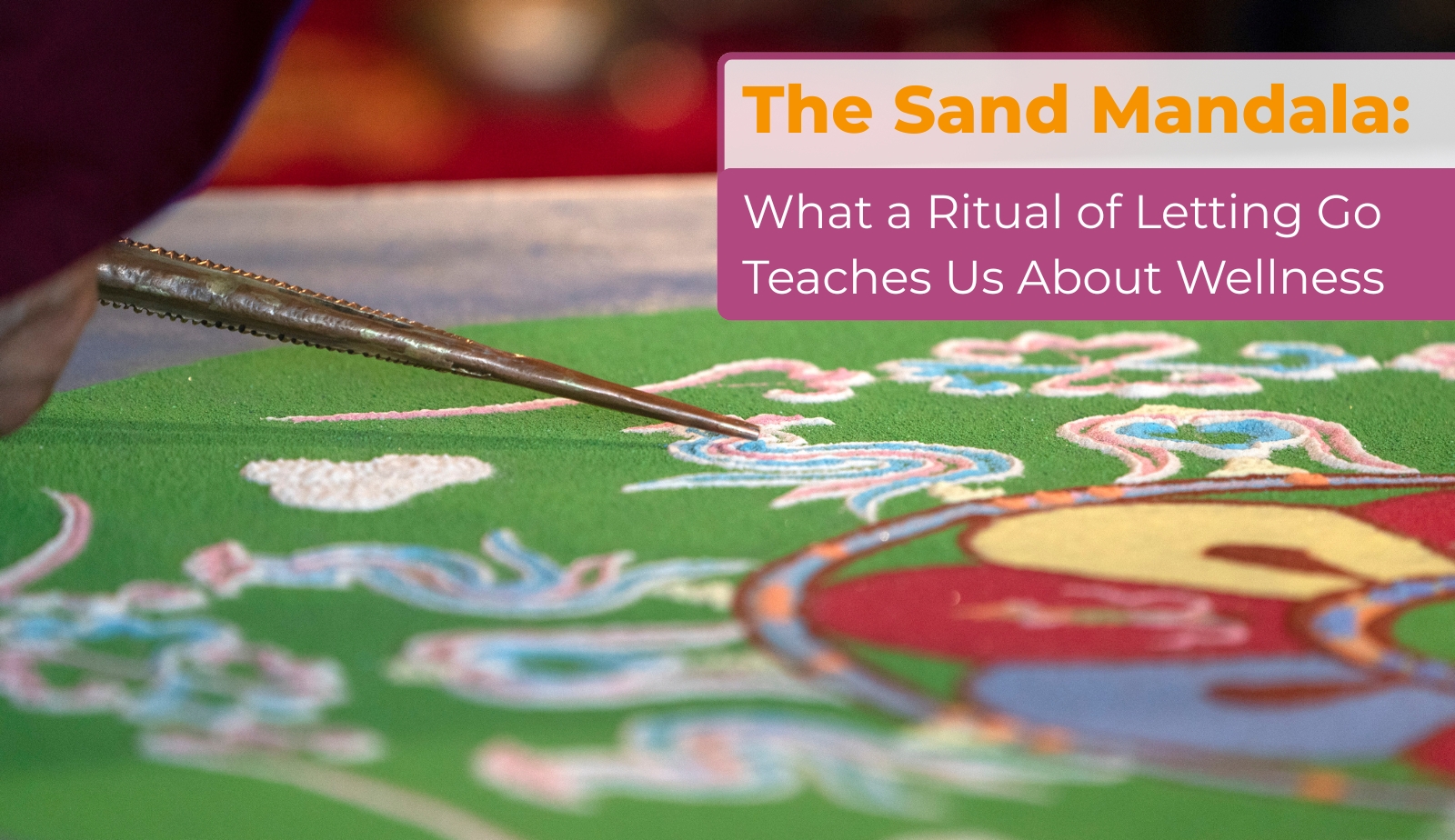
A sand mandala (in Tibetan, dul-tson-kyil-khor, “mandala of colored powders”) is a sacred geometric artwork built from crushed, dyed stone or sand. Working from the center outward, monks use a ridged metal funnel called a chak-pur, running a rod along its grooves so the sand flows out in a stream fine enough to draw a single line. A large mandala can take a team of monks many days of continuous, meditative work.
Every element is symbolic – the palace at the center, the gates at the four directions, the rings of lotus petals and flame. But the most important symbolism arrives at the end. Once completed and consecrated, the mandala is ceremonially dismantled: the sand is swept from the edges toward the center, undoing in minutes what took weeks to build. The gathered sand is often released into flowing water, carrying the mandala’s blessing outward into the world.
The Philosophy: Impermanence Is Not Loss
Why build something exquisite only to erase it?
Because the mandala was never meant to last. Its dissolution embodies one of Buddhism’s deepest teachings: anicca – impermanence. Everything that arises passes away. Health, youth, seasons, moods, even our carefully constructed routines. The monks are not indifferent to beauty; they are practicing non-attachment to it. The value was never in possessing the mandala. It was in the making, and in the release.
Traditional Chinese Medicine holds a parallel wisdom. Health is not a fixed state to be achieved and defended — it is a flow to be maintained. Qi that stagnates becomes disease; a river that stops moving becomes a swamp. The healthy body is not the one that holds on. It is the one that circulates, releases, and renews.
Both traditions arrive at the same clinical observation from different directions: holding on is the pathology. Letting go is the medicine.
What We Hold Onto – And What It Costs Us
Most of us live as if the goal were accumulation and preservation. We accumulate commitments, screen time, stress, late nights, sugar, and the low-grade inflammation that follows all of them. And we preserve – habits that stopped serving us years ago, standards of “pushing through” that our bodies quietly protest.
The cost shows up in familiar ways: digestion that feels heavy and sluggish, sleep that doesn’t restore, energy that dips by mid-afternoon, a mind that can’t settle. In TCM terms, this is stagnation – of Qi, of digestion, of spirit. In modern terms, it’s the accumulated burden of a system that never gets a genuine pause.
The sand mandala asks a quietly radical question: what would you be willing to sweep away?
Letting Go as a Wellness Practice
The monks don’t sweep the mandala away in grief. The dissolution is a ceremony – deliberate, structured, and complete. That structure matters. “Letting go” as a vague intention rarely survives a stressful Tuesday. Letting go as a ritual – with a defined beginning, a form, and an end – actually happens.
This is the philosophy behind a well-designed reset. Not deprivation, not punishment, not the fantasy that you’ll dissolve years of habits in three days. A reset is a structured, time-bound ritual of release: a few days when you deliberately set down the caffeine, the sugar, the heavy load on your digestion – and give your body the pause it has been asking for.
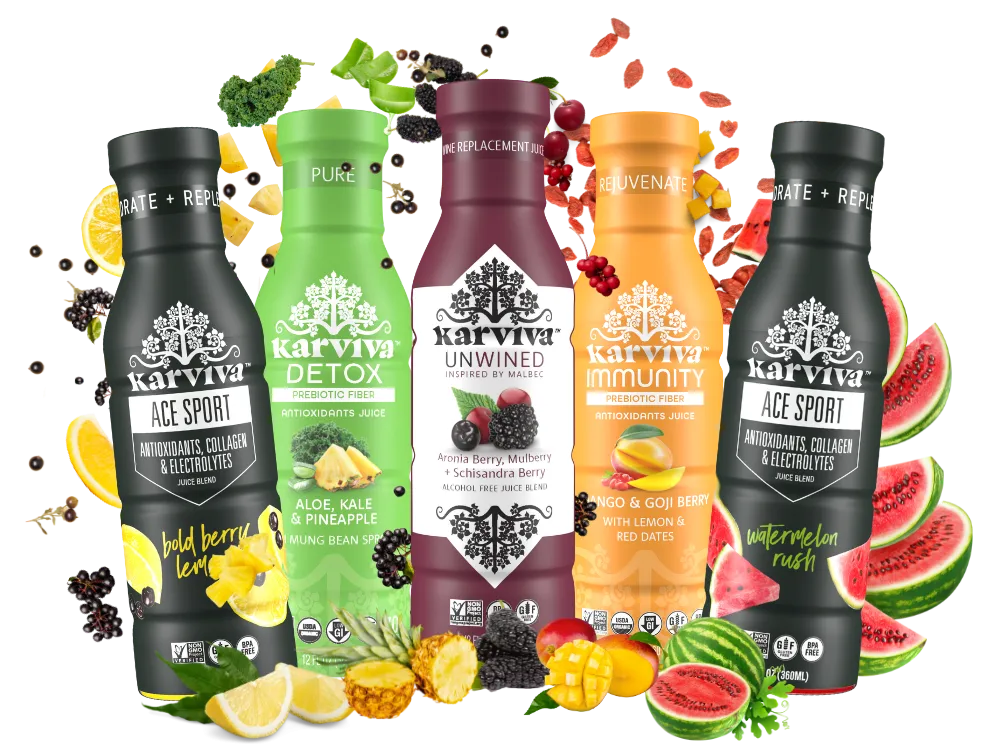
This is exactly how we designed the Karviva Wellness Reset. Unlike a typical juice cleanse – which strips away fiber and floods the body with 30–50 grams of sugar per bottle – our whole-food blends keep the fiber, keep the protein, and keep sugar to just 5–8 grams per serving. Ingredients like goji berry, schisandra, and aronia berry are chosen from centuries of TCM wisdom to support the body’s own capacity to clear and renew. Strategic nourishment, not deprivation. You are not emptying yourself. You are sweeping toward the center, and releasing what no longer serves.
Beginning Again Is the Practice
Here is the detail people miss about sand mandalas: after the sweeping, the monks build another one. And another. The dissolution is never the end of the practice – it is what makes the next creation possible.
Wellness works the same way. There is no final state, no finished mandala you get to keep. There is only the rhythm: build good habits, live fully inside them, notice when accumulation has crept back in, release, and begin again. A seasonal reset. A weekly sabbath from screens. An evening ritual of setting the day down. The form matters less than the rhythm.
The monks pour the sand into the river so its blessing flows outward. When you release what your body has been carrying, something similar happens – energy that was tied up in coping becomes available for living.
Impermanence, it turns out, is not the sad truth we must accept. It is the mechanism of renewal. Nothing new can be built on a platform that’s still full.