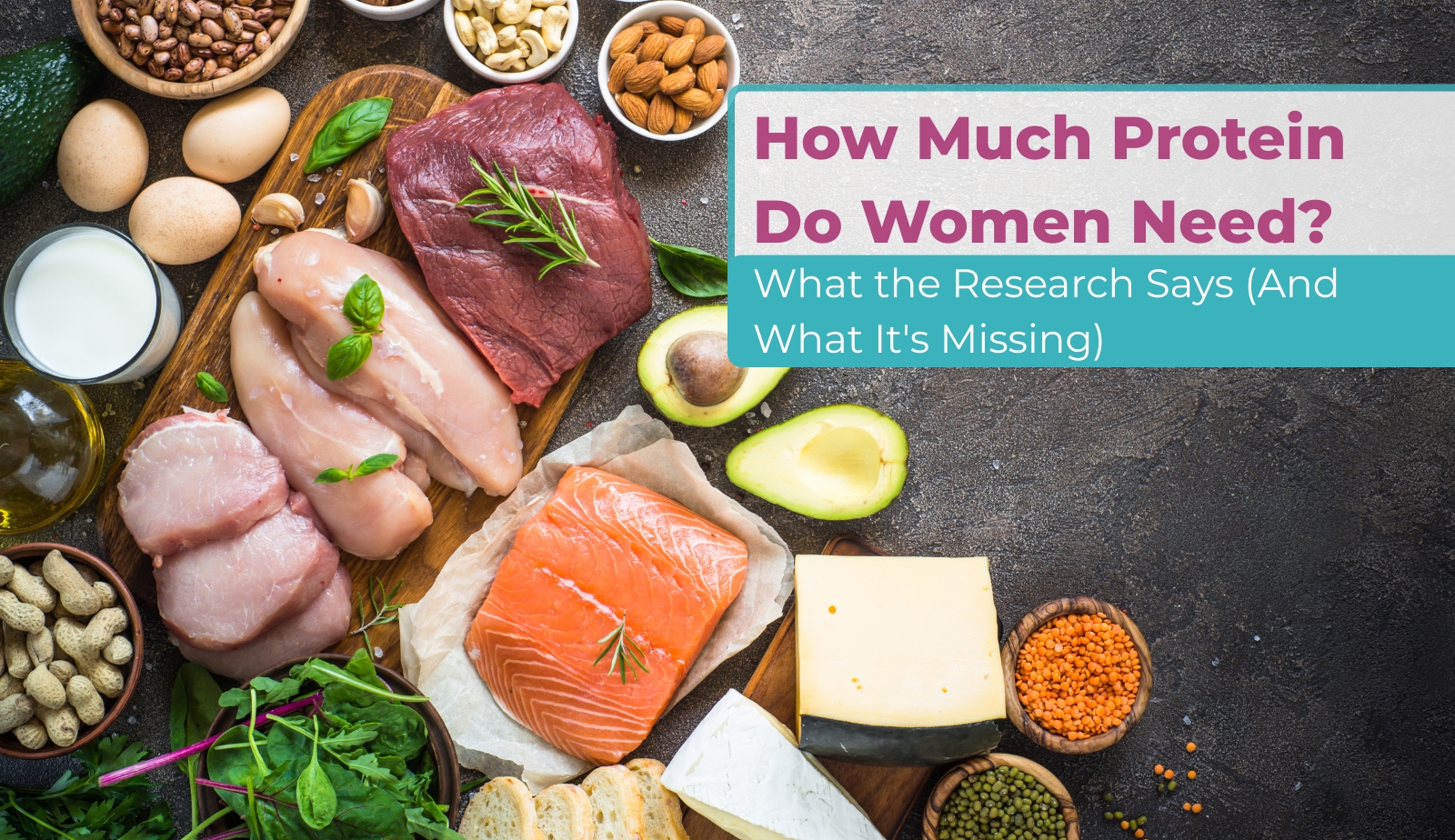





Women need more protein than most standard recommendations suggest — particularly active women, women over 40, and women working to maintain muscle through perimenopause. Research supports 1.2 to 2 grams of protein per kilogram of body weight daily for active women, distributed across meals, paired with adequate carbohydrates. Without both components, neither protein nor carbohydrates can do their jobs effectively.
Why Women’s Protein Needs Are Different — and Higher Than You Think
The RDA for protein — 0.8 grams per kilogram of body weight — was established to meet the needs of 98% of sedentary adults. The moment a woman exercises regularly, this number is insufficient for recovery, muscle maintenance, or the hormonal biosynthesis that protein supports.
For active women, current research points to a practical range of 1.2 to 2 grams per kilogram per day:
• Moderate exercise (3–4 days/week): 1.2–1.4 g/kg
• Regular strength or endurance training: 1.6–1.7 g/kg
• Intense training or body recomposition: up to 2.2 g/kg
For a 130-pound (60 kg) woman, this means 72 to 132 grams of protein daily. Many women discover, when they actually track their intake, that they’re consistently under 60 grams — less than half of what recovery and muscle synthesis require.
The stakes are higher for women as they age. After perimenopause, the decline in estrogen significantly impairs muscle protein synthesis — meaning older women actually need more protein to achieve the same muscle-building response as younger women. Sarcopenia (age-related muscle loss) is not inevitable, but it does require deliberate and sufficient protein intake to prevent.
How Much Protein Can Women Absorb at One Time?
Here is where the “eat more protein” message often goes wrong: it isn’t just about how much protein you eat over the course of a day. It’s about when and how you distribute it.
Research consistently shows that muscle protein synthesis is maximally stimulated by approximately 20 to 40 grams of protein per meal. Eating 80 grams of protein at dinner does not produce double the anabolic effect — the excess is used for energy or excreted. One study using casein (a slowly digested dairy protein) suggested higher single-meal absorption is possible with that specific source, but for most dietary protein, the 20–40 gram per meal guideline holds.
The practical implication: protein should be spread across the day, with a meaningful serving at breakfast, lunch, and dinner, and a smaller amount after exercise. Women who skip breakfast or eat protein-light mornings and then try to compensate at dinner are not getting the recovery benefit they’re working toward.
In TCM, this reflects the clinical wisdom of the *Spleen*: the digestive system performs best with regular, moderate nourishment. Large infrequent meals strain the Spleen’s transformative capacity. Small, consistent servings of quality food across the day are how the Spleen generates the *Blood* and *Jing* that sustain vitality, muscle integrity, and hormonal health.
The Critical Role of the 45-Minute Post-Workout Window for Women
This is one of the most important and least-known differences between women’s and men’s post-workout physiology: women have a significantly narrower anabolic window after exercise.
Research shows women should consume protein within 45 minutes of finishing exercise. Men can wait up to three hours and still get comparable muscle synthesis benefit. For women, missing this window consistently means consistently incomplete recovery – regardless of how much total protein is consumed throughout the day.
Within this 45-minute window, muscles are depleted and exceptionally receptive to both glucose and amino acids. The optimal post-workout strategy for women is not just protein – it is protein paired with carbohydrates. Without carbohydrates in this window, the body defaults to cortisol-driven gluconeogenesis: manufacturing glucose from amino acids, including the ones you just ate. The protein intended for muscle repair gets redirected to fuel production instead.
Post-workout target:
• 20–30 grams of protein from a quality whole-food source
• 30–50 grams of carbohydrates to replenish glycogen and halt cortisol production
• Eaten together, within 45 minutes of finishing training
Plant-Based Protein for Women: What Works and What Doesn’t
Animal proteins – fish, poultry, eggs, quality dairy – provide complete amino acid profiles in highly bioavailable forms. For women who include them, they are straightforward and effective.
For plant-based or plant-forward women, protein requires more intention – not because it’s impossible, but because most individual plant sources are incomplete and some are harder to digest than they appear. Here is what the research and clinical experience support:
Tofu (organic, non-GMO): ~20g per cup. One of the more complete plant proteins, with a long history in East Asian herbal medicine for supporting women’s hormonal health. The isoflavones in soy are phytoestrogens – they occupy estrogen receptors weakly, which can be beneficial in perimenopause and does not increase breast cancer risk in the amounts found in whole soy foods.
Hemp seeds: ~10g per 3 tablespoons. One of the most complete plant proteins available, with an ideal omega-3 to omega-6 ratio and high magnesium content – a mineral that many active women are deficient in and that supports sleep, muscle recovery, and blood sugar regulation.
Lentils and legumes: 12–15g per cup. Rich in fiber, iron, and folate. Incomplete in isolation (low in methionine), but excellent when combined with grains. Soak and cook thoroughly for optimal digestion and absorption; raw or undercooked legumes can cause significant digestive discomfort during exercise.
Quinoa: A complete protein grain at ~8g per cup cooked. Must be cooked until genuinely soft – al dente quinoa passes through the gut largely undigested and provides far less protein than the label suggests.
Eggs: ~6g each. An excellent and affordable source, but commonly miscalculated. Two eggs at breakfast provides 12 grams – a solid start, not a complete daily protein strategy.
What to avoid as primary sources: Nuts, seeds (except hemp), and spirulina are often marketed as protein foods, but their amino acid profiles are incomplete and the amounts are small. Use them as additions, not foundations. Pumpkin seeds and almonds are low in lysine; spirulina provides only 4 grams per serving.
Dietary Fats: The Overlooked Recovery Nutrient for Women
Beyond protein and carbohydrates, fat plays a meaningful and underappreciated role in women’s recovery and hormonal health.
All steroid hormones – estrogen, progesterone, cortisol, testosterone – are synthesized from cholesterol. Adequate dietary fat is not optional for women who want hormonal sufficiency. The quality of fat determines its downstream effect on inflammation, hormone production, and the absorption of fat-soluble vitamins A, D, E, and K.
For women who train regularly, priorities include:
Omega-3 fatty acids from cold-water fish (salmon, sardines, mackerel), walnuts, flaxseed, and hemp seeds. Omega-3s directly reduce the inflammatory response generated by training, are particularly important during the luteal phase when inflammation peaks, and support brain function and mood stability — all of which are influenced by the same hormonal systems exercise affects.
High-quality olive oil as a daily anchor. Rich in polyphenols and monounsaturated fats, deeply embedded in longevity traditions across cultures and increasingly supported by research on cardiovascular health, anti-inflammatory signaling, and metabolic function.
One note of caution: if you’re newly introducing concentrated fat sources – MCT oil, coconut oil, or large amounts of any new fat – go slowly. The digestive system adapts to fat intake gradually, and aggressive introduction commonly causes gastrointestinal distress that disrupts both exercise and absorption.
The Ancient Framework: Restoration Through Complete Nourishment
Traditional Chinese Medicine understood recovery not as a single-nutrient question but as a restoration of *Jing* – the deep vital essence depleted by exertion. Jing is replenished through the full spectrum of nourishment: the grains and root vegetables that generate *Gu Qi*, the proteins and warm cooked foods that build *Blood*, the fats that nourish the *Kidney* (the system governing hormonal reserves and reproductive vitality).
No single food restores Jing. No single macronutrient is sufficient. The intelligence of ancient medicine was systems-level: recognize what the body has spent, and return it in kind – diverse, whole, consistent, and well-timed.
This is the principle that Karviva was built on. Strategic nourishment: giving the body what it actually needs, when it needs it, rooted in traditions that have observed women’s health for thousands of years and confirmed by the science that keeps catching up.