





Search “foods that help you sleep” and you’ll get the same list every time. Kiwifruit. Tart cherry juice. Magnesium. Warm milk. Turkey.
I went and read the actual studies behind that list, and I came back with a more complicated answer than I expected. Some of it holds up. Some of it is one small uncontrolled study that has been repeated so many times it now reads as established fact. And one item on the popular list involves a dose that would concern a neurologist.
So this article is the honest version. What the evidence supports, what it doesn’t, and what Chinese food therapy adds that the nutrition literature hasn’t gotten around to testing properly.
A note on why this matters for the rest of the series. The whole argument across these seven articles has been that the recharge is a real physiological process that can be interrupted – by alcohol, by a broken night, by not spending enough energy during the day. Food is the input side of that process. It won’t fix a four-hour night. But it can stop working against you.
What the Evidence Actually Supports
Tryptophan: real, but not from food
Tryptophan is a precursor to serotonin and melatonin, which is why it’s the theoretical backbone of half the sleep-food advice on the internet.
A 2022 systematic review looked at 18 trials and was able to pool four of them. Tryptophan significantly reduced the amount of time spent awake after falling asleep. A real effect, on a thin evidence base – four trials is a narrower foundation than the magnesium literature I’m about to be sceptical about, and I should be consistent.
The catch is the dose. The benefit appeared at one gram or more, and the meta-regression put it at roughly 81 minutes of improvement per gram. It did not significantly change how long people took to fall asleep or total sleep time.
One gram is far more tryptophan than any meal delivers. And dietary tryptophan has to compete with other amino acids for transport into the brain, which is why the turkey-makes-you-sleepy story has never held up. This is supplement evidence, not food evidence, and anyone who cites it as a reason to eat a particular dinner is stretching it.
Glycine: promising, thin
Three grams of glycine before bed improved subjective sleep quality, shortened time to fall asleep, and improved sleep efficiency without distorting sleep architecture, in a study that also used polysomnography.
It’s a genuinely interesting finding. It’s also from 2007, small, from a single research group with industry ties, and has not been independently replicated at scale. Interesting, not established.
Magnesium: quote the researchers’ own verdict
A meta-analysis of three trials in 151 older adults found magnesium shortened time to fall asleep by about 17 minutes versus placebo. Total sleep time increased by 16 minutes, which was not statistically significant.
Then the authors said something that almost no wellness article quotes: they rated their own evidence base as “low to very low quality” and wrote that “the quality of literature is substandard for physicians to make well-informed recommendations.”
That’s the researchers, not a sceptic. Magnesium may help. Three small trials in older adults is not a basis for the confidence with which it’s usually sold.
Kiwifruit: the most over-cited study in sleep nutrition
You’ll see this one everywhere: two kiwifruit an hour before bed, four weeks, sleep onset time down 35%, waking in the night down 29%, and sleep quality scores improving by 42%.
Those numbers are real, and they come from a 2011 study of 24 people. Here’s what almost never gets mentioned: there was no control group, no placebo, and no randomization. It was a self-controlled before-and-after design. Every one of those percentages is a within-person change that cannot be separated from placebo effect, expectancy, or simple regression to the mean, because the study had no way to separate them.
Kiwifruit are excellent food. Eat them. But that 42% figure should not be presented as a trial result, and I’d gently suggest that any wellness brand quoting it without this caveat either hasn’t read the paper or is hoping you won’t.
Tart cherry: promising and unproven
Here I’ll give you both halves, because most articles give you one.
The positive half: a 2023 meta-analysis found significant pooled improvements in objectively measured total sleep time and sleep efficiency. That’s a real finding and it deserves stating.
The cautious half: the individual trials are tiny – fifteen people, twenty people, eight completers – at least one was supported by a cherry industry supplier, subjective sleep measures showed nothing, two later trials found no effect at all, and heterogeneity on total sleep time ran above 81%, which in plain terms means the studies disagree with each other badly.
So: better evidence than I expected, on samples small enough that I wouldn’t spend much on it. Worth trying, not yet demonstrated.
Vitamin B6 and dreams: please don’t
This one comes up constantly in dream-recall discussions, and it needs a clear correction.
The study people are referring to is a 2018 randomized placebo-controlled trial in 100 participants, and it found that B6 increased dream recall. It found no effect on vividness, on bizarreness, on colour, or on any sleep parameter. So the popular claim, “B6 makes your dreams more vivid,” is the opposite of what the study reported.
More importantly: the dose was 240 mg per night, roughly 185 times the recommended daily intake, and in territory associated with sensory nerve damage. Several countries cap supplemental B6 far below this level.
I’m including it so you have the accurate version, not as a suggestion. If you want better dream recall, the answer is a longer night and a gentler waking, not a mega-dose of a vitamin.
Late dinner: weaker than everyone assumes, including me
I’ve told people for years to eat earlier. I still think it’s right, but the evidence is softer than I’d been treating it.
The one polysomnography trial I could find compared dinner one hour before bed against dinner five hours before, in twenty people. Total sleep time, sleep efficiency, sleep latency and overall stage distribution were all unchanged. The significant differences were narrow and not in the direction people assume: more stage 2 sleep in the second quarter of the night after the late meal, slightly more REM in the third quarter, and a small rise in early-night deep sleep activity.
The large population data does associate later last meals with worse self-reported sleep, in over 7,000 NHANES participants. But that’s cross-sectional and self-reported, and a later first meal correlated almost as strongly as a later last meal, which suggests some of the signal may be about being a late chronotype generally rather than about dinner specifically.
So the honest position: eating late is weakly associated with worse sleep in surveys and has not been shown experimentally to damage sleep architecture. What is well established is that a heavy meal close to bed causes reflux and discomfort in people prone to it, and that alcohol with dinner does real measurable harm. Eating earlier and lighter is still what I do and what I’d suggest. I just won’t tell you the sleep lab has proven it, because it hasn’t.
What Chinese Food Therapy Adds
Here the evidence gets thinner and the observational record gets much longer. I’ll be clear about which is which.
The organizing idea, from the last two articles: the Shen has to be anchored by something material to rest, and Blood and Yin do the anchoring. So the dietary approach to disturbed sleep and excessive dreaming isn’t sedation. It’s building the substance that lets the system settle. That’s a genuinely different premise from most Western sleep nutrition, which is looking for a compound that induces drowsiness.
The traditional foods:
- 酸枣仁 (suān zǎo rén), sour jujube seed. The central herb for dream-disturbed sleep, and the chief ingredient of 酸枣仁汤 (Suan Zao Ren Tang), a formula from the Jin Gui Yao Lue – attributed to Zhang Zhongjing around 200 to 220 CE, though the text as it came down to us was recovered and edited in the eleventh century – prescribed for “deficiency vexation and inability to sleep.” It’s classified as a food-homologous substance in China, meaning it’s officially recognized as both food and medicine. This is the one with real modern data: a 2018 systematic review of 13 randomized trials in 1,454 patients found Suan Zao Ren formulas outperformed placebo, with fewer adverse effects than pharmaceutical comparators. The caveats are significant – only four of thirteen trials used allocation concealment by the review’s own tally, treatment ran anywhere from two weeks to three months, only five trials reported any follow-up at all, herb quality varied, and all thirteen were conducted in China and published in Chinese, a literature with known publication bias. An independent Australian trial in 2021 was positive but had twelve completers and was explicitly a feasibility study. Promising enough to justify a proper trial, which nobody has run yet.
- 龙眼肉 (lóng yǎn ròu), longan flesh. Sweet and warm, entering Heart and Spleen. Tonifies Blood and calms the Shen. One of the blood-nourishing herbs in 归脾汤 (Gui Pi Tang), the classic formula for the Heart-and-Spleen deficiency pattern. Traditional use only, no clinical trials.
- 百合 (bǎi hé), lily bulb. Sweet and slightly cooling, entering Heart and Lung. Nourishes Yin, clears heat from the Heart, settles the Shen. It’s the namesake of 百合病, “lily disease,” a classical syndrome of restlessness, insomnia and disorientation described in that same text. Traditional use only.
- 莲子 (lián zǐ), lotus seed. Tonifies the Spleen, quiets the Heart. The green plumule inside, 莲子心 (lián zǐ xīn), is bitter and cold and used specifically to clear Heart fire – it’s the classic bedtime tea for someone who is wired and restless rather than depleted. Traditional use only.
- 大枣 (dà zǎo), red dates, and 浮小麦 (fú xiǎo mài), floating wheat. The other two ingredients in 甘麦大枣汤 (Gan Mai Da Zao Tang), prescribed in the Jin Gui Yao Lue for 脏躁 (zàng zào), visceral agitation, in a passage specifically about women: “given to sorrow and weeping as if possessed, frequently yawning and stretching.” Three ordinary kitchen ingredients, described eighteen hundred years ago, for a state most of us would now call being completely frayed. Traditional use only.
- 茯苓 (fú líng), poria. Bland and neutral, drains damp and quiets the Heart. Also in Suan Zao Ren Tang. Food-homologous status in China.
Two honest flags. 柏子仁 (bǎi zǐ rén), biota seed, turns up constantly on wellness lists of “TCM sleep foods.” It is a medicinal herb and does not have food status in China, so it doesn’t belong on a food list. And millet (小米), which you’ll see described as a classical Shen-calming food, isn’t one — its sleep reputation in China comes from popular dietary custom and the logic of 胃不和则卧不安, harmonizing the stomach, not from a classical spirit-calming indication. It’s a good gentle evening grain. It just isn’t what it’s often claimed to be.
I should also be square about the field as a whole. A systematic review of Chinese herbal medicine for insomnia screened 217 studies and found only eight of reasonable methodological quality, seven of which still carried a high risk of bias, and concluded the evidence was insufficient to establish efficacy. It did find that adverse events were placebo-like and lower than with conventional sleep medication. Safety, yes. Proven efficacy, not yet.
What I’d Actually Do
Sorting all of that into something usable:
- Fix the big variables first. A full night, a consistent schedule, morning light, and no alcohol close to bed will outperform every food on this page combined. Nothing below matters if those are wrong.
- Eat earlier and lighter, for comfort as much as architecture. Stopping at about 70% full and finishing three hours before bed. The line 胃不和则卧不安 — when the stomach isn’t settled, lying down isn’t peaceful – is quoted in Su Wen 34 from an even older text now lost, and remains the most practical sentence in the whole tradition.
- Build blood-nourishing foods into the day, not just the evening. This is the real shift in the Chinese approach. Red dates, longan, black sesame, dark leafy greens, beans, whole grains, adequate protein. You’re not looking for a nightcap effect. You’re building the substrate over weeks.
- Try a warm evening ritual with lotus seed, lily bulb or red date. Traditional rather than proven, low risk, and the ritual itself has real value: a consistent wind-down sequence does more for sleep onset over time than most single ingredients.
- Skip the mega-dose supplements. Particularly B6 at dream-recall doses. If you try magnesium or tart cherry, go in knowing the evidence is preliminary, and give it three weeks before deciding.
- Talk to your doctor before adding herbs if you’re pregnant, breastfeeding, on medication, or managing a health condition. Sour jujube seed in particular is a real pharmacological agent, not a garnish.
Where Karviva Fits In
Everything above is why Karviva is built the way it is.
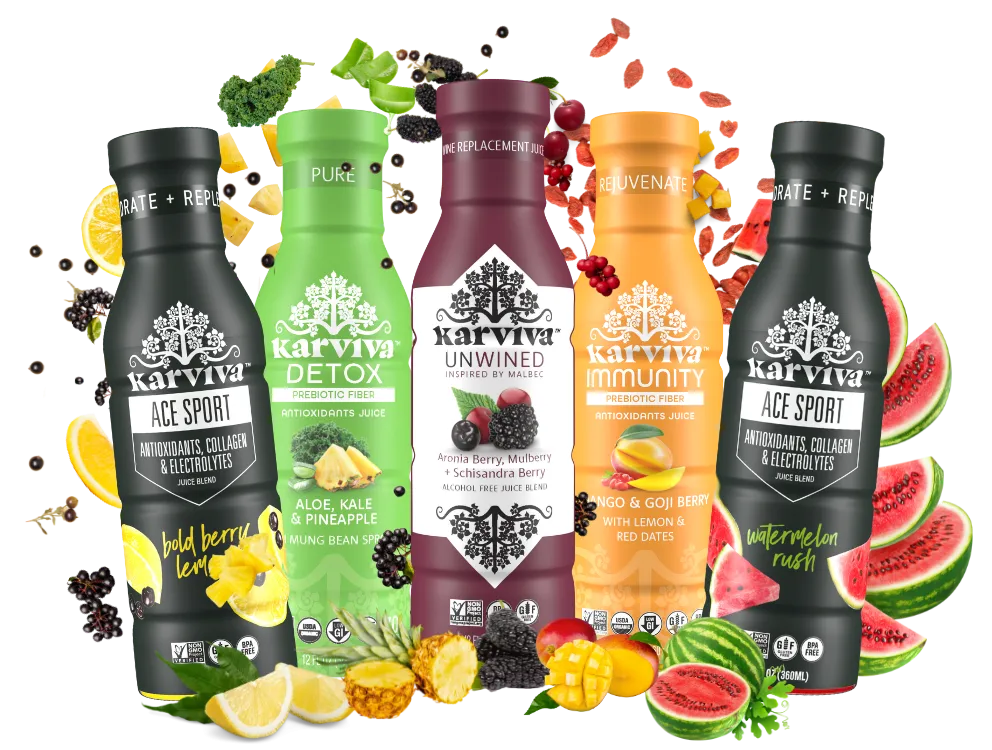
The whole-plant approach comes directly from this tradition. Chinese dietary therapy never isolated a compound and dosed it — it used whole foods, in combination, over time, to build something. That’s the same instinct behind the Karviva Wellness Reset: a whole-plant blend with 5 to 8 grams of naturally occurring sugar per serving and no added sugar, with schisandra, which classical materia medica place in the Heart and Kidney and use in the formulas for restless sleep, and goji berry, a Liver-and-Kidney herb long associated with the restorative, yin side of the cycle. Not a sedative. Nourishment on the input side.
And Karviva Unwined exists for the specific problem this series keeps returning to. Made with red grapes, ashwagandha and holy basil, it’s built to occupy the slot where the evening glass of wine usually goes, so that changing the most disruptive input to your night doesn’t mean giving up the ritual that makes the evening feel finished.
These are foods and beverages, not medicines or sleep aids, and I’d rather say that plainly than imply otherwise. What food can do is stop working against the recharge and start supporting it. That’s a smaller claim than most of this category makes, and it’s the one I can stand behind. The Seven Nourishments idea I keep coming back to says it better than I can: the goal was never to sedate the body into stillness. It was to give it enough that it could rest on its own.