




Traditional Chinese Medicine and Ayurveda developed thousands of miles apart, in different languages, with different maps of the body. Yet on summer, they reached the same conclusion: the season’s heat must be balanced from within — through cooling foods, calming herbs, and a rhythm that yields to the sun instead of fighting it. When two traditions with several thousand years of clinical observation between them independently agree, it’s worth listening.
Two Traditions, One Summer Prescription
In TCM, summer belongs to the Fire element – the season of warmth, joy, and outward-moving energy. Fire is not the enemy; it’s the energy of full bloom, of life at its most expansive. But when external heat piles onto internal fire, the system tips out of balance: restlessness, poor sleep, irritability, flushed skin, scattered focus.
Ayurveda tells the same story in its own vocabulary. Summer is Pitta season -Pitta being the dosha of fire and transformation. When Pitta accumulates, the signs are nearly identical to TCM’s excess heat: inflammation, impatience, skin flare-ups, burning digestion.
Different maps, same territory. And the same treatment principle: don’t add fire to fire. Cool the body through what you eat, how you move, and when you rest.
Eat With the Season: The Cooling Foods List
Both traditions classify foods by their energetic temperature – not how hot they are served, but what they do inside the body. Summer’s table should lean cooling and hydrating:
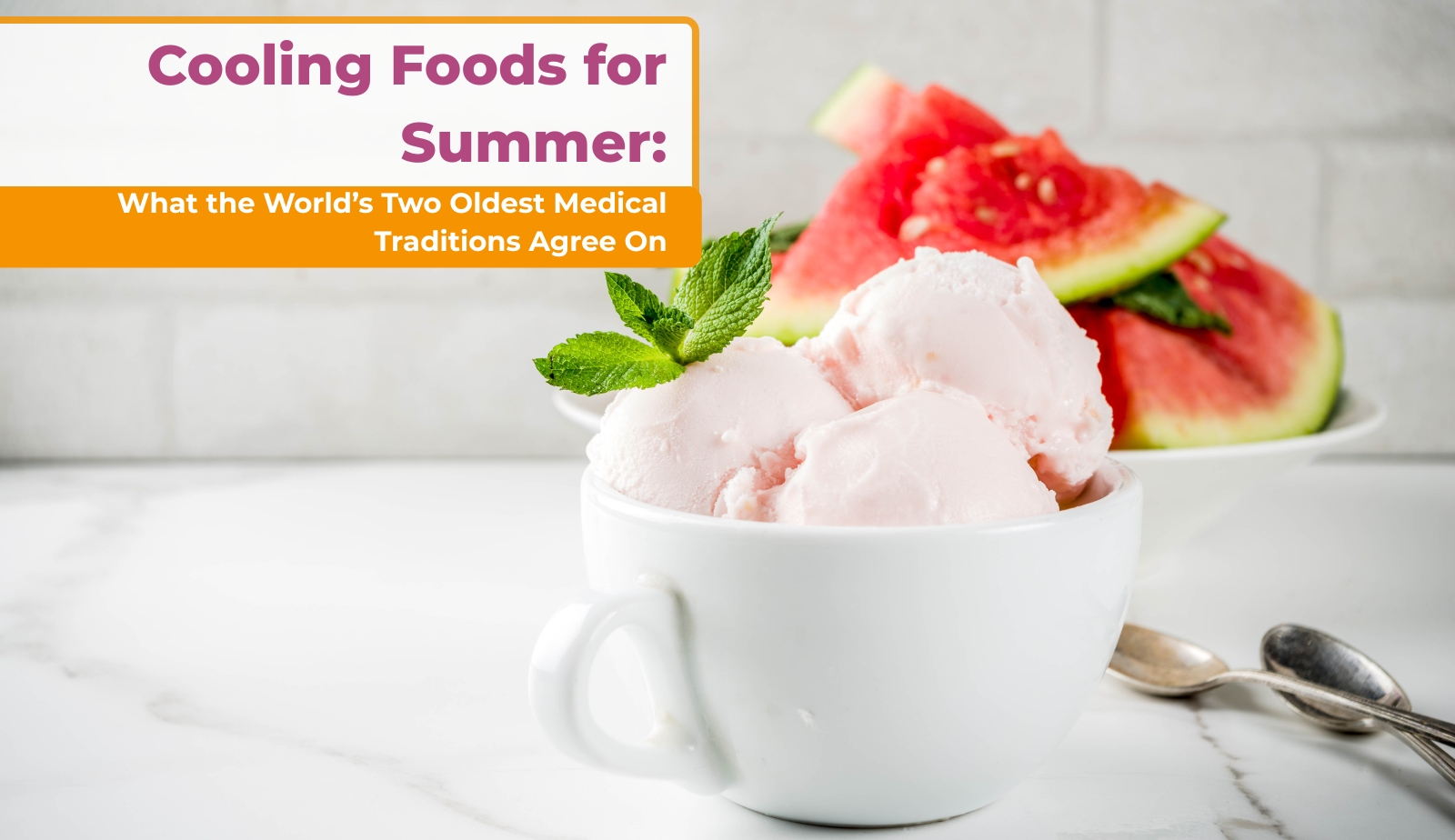
- Melons and summer fruits. Watermelon is TCM’s classic summer remedy – it clears heat and replenishes fluids at once. Strawberries and cherries offer gentler cooling with antioxidant depth.
- Water-rich vegetables. Cucumber, zucchini, and tomato hydrate as they nourish. Cucumber in particular is prized in both traditions for clearing heat without chilling digestion.
- Bitter greens. In TCM, the bitter flavor drains excess fire – this is why bitter greens, kale, and barley grass matter most in summer. Ayurveda agrees: bitter is the premier Pitta-pacifying taste.
- Mung beans. The classic Chinese summer soup for a reason: cooling, easy to digest, and gently detoxifying.
- Fresh herbs. Basil, cilantro, and mint turn any dish toward the season.
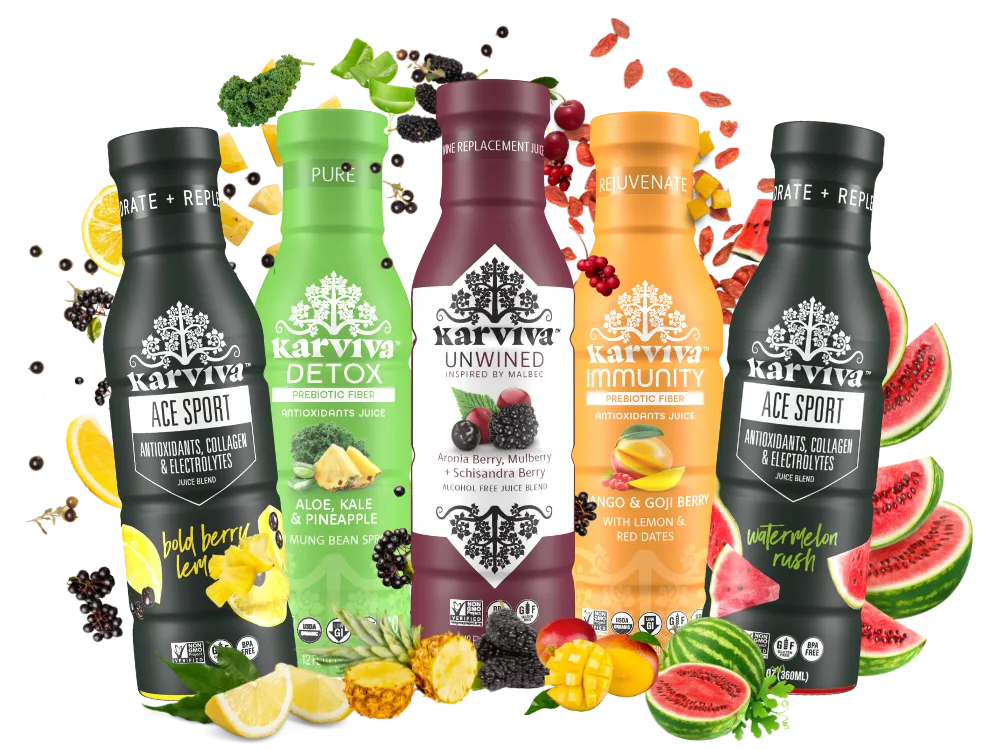
You’ll recognize several of these – cucumber, kale, sprouts, barley grass – as anchors of Karviva’s blends. That’s not coincidence. Formulating with TCM means formulating with the seasons in mind.
One caution both traditions share: cooling foods, not ice-cold everything. Freezing drinks with every meal can weaken digestive fire so much that food sits poorly. Aim for cool and room-temperature most of the time; save iced treats for genuine heat.
Peppermint: Summer’s Signature Herb
If summer had one herb, it would be peppermint (Mentha × piperita). Rich in menthol, it delivers a genuinely measurable cooling effect – menthol activates the same cold-sensing receptors in your skin and mouth (TRPM8) that respond to actual cold temperatures. Your nervous system registers coolness, and the body’s perception of heat eases.
TCM classifies mint (bo he) as cool and dispersing – it releases heat from the body’s surface and benefits the head and eyes, which is why it clears that heavy, foggy summer-afternoon feeling. It also supports digestion, easing the sluggishness that heavy heat brings.
Use it simply: fresh peppermint tea (hot or cooled), a handful of leaves in your water pitcher, or torn over fruit salads. Herbal iced teas – mint, chrysanthemum, hibiscus – are the summer drink both traditions would recognize: flavorful, cooling, and free of the 30–40 grams of sugar hiding in most commercial “refreshment.”
Live With the Season: The Pitta Playbook
Food is half the prescription. The other half is rhythm:
- Rise earlier. Ayurveda advises using the cool early morning for exertion – exercise, errands, focused work – before the day’s heat builds.
- Yield at midday. Both traditions counsel rest, shade, and lighter activity during peak heat. This echoes the Chinese sanfu wisdom we explored in our mid-year reset guide: fu means to lie low.
- Seek water and green. Time near water, or simply in nature, is standard Pitta-season advice – and modern research on stress physiology keeps validating it.
- Cool the evening. A lukewarm (not cold) shower, a screen-free wind-down, and a cooler bedroom protect summer sleep, when the body most needs its temperature to drop.
Don’t Forget Your Skin
Summer skin takes the season’s full force – sun, sweat, and heat all at once. Botanical research continues to explore how plant compounds support skin during high-UV months: green tea polyphenols have been studied for their photoprotective antioxidant activity, while calendula and aloe remain the classic soothers for sun-stressed skin. None of these replace sunscreen – but they reflect the same principle at the surface that cooling foods serve within: help the body buffer heat rather than simply endure it.
Skin health also starts internally. Hydrating foods, antioxidant-rich berries like aronia, and adequate protein give skin the raw materials to repair summer wear.
The Deeper Pattern
Step back and the pattern is hard to miss. Two ancient systems, developed independently, converged on one summer strategy: cool from within, yield to the season, and let food do the work. Modern physiology keeps arriving at the same place – hydration status, heat stress, and diet quality drive how well we tolerate summer.
This is the philosophy Karviva bottles: whole-food, plant-forward nourishment with the season’s logic built in – real hydration, cooling ingredients, 5–8 grams of sugar per serving instead of a sugar load your body must burn through in the heat.
Summer is the season of vitality and expansion. Meet it cooled, rested, and nourished – and it gives you its best.