




Are Rapid Detox Cleanses Safe?
The honest answer: generally, no—and the reason has nothing to do with willpower or sensitivity. It’s basic physiology.
Your body protects itself from toxic overload by tucking fat-soluble toxins inside fat cells, keeping them safely out of circulation. When aggressive caloric restriction causes fat to break down quickly, those stored compounds re-enter the bloodstream faster than the liver and kidneys can process them. That’s the real reason so many people feel genuinely terrible during or after a rapid cleanse—not because it’s “working,” but because their detox pathways are overwhelmed.
If you’ve ever pushed through a hardcore 3-day detox feeling headachy, nauseous, foggy, and exhausted—and someone told you “that’s just the toxins leaving”—I want to offer a more accurate explanation.
The toxins are moving, yes. But they’re not necessarily leaving. In many cases, they’re being redistributed—released from storage faster than your liver, gut, and kidneys can deal with them. That’s why you feel sick.
This post is the one in the series that most directly contradicts what mainstream cleanse marketing tells you. It’s also the one most grounded in straightforward physiology. Once you understand how this mechanism works, a “3-day rapid detox” starts to look very different.
Suggested image: A diagram showing a fat cell releasing stored toxins into the bloodstream during rapid weight loss. Alt text: “Fat cell releasing stored toxins into the bloodstream during rapid weight-loss cleanse, overwhelming liver detox pathways.”
Why Does the Body Store Toxins in Fat?
I touched on this briefly in Post 1, but it’s worth looking at more closely—because almost no one selling a quick cleanse will bring it up.
When your daily toxic load exceeds what your liver and kidneys can process in real time, your body does something remarkably protective: it stores those fat-soluble compounds inside fat cells, removing them from active circulation until there’s capacity to deal with them properly.
This is not a failure of your detox system. It’s a feature of it.
Fat-soluble compounds—many pesticides, heavy metals, plasticizers, certain pharmaceutical residues, used hormones—would cause genuine damage if they remained freely circulating in the blood. Storing them is, biologically speaking, like putting hazardous waste into a sealed container until a proper disposal team arrives.
Which means right now, a portion of your body fat is quietly doing detox work on your behalf.
What Actually Happens During a Rapid Weight-Loss Cleanse
Let’s trace the sequence of events in a typical 3-day rapid cleanse—the kind that promises five, eight, or even ten pounds lost in a week.
- Fat cells shrink quickly. Severe caloric restriction triggers rapid lipolysis—the breakdown of fat for energy.
- Stored compounds are released. Shrinking fat cells release everything they’ve been holding, including whatever toxins were stored there.
- Those toxins re-enter the bloodstream. They’re circulating again.
- The liver hits a processing ceiling. Phase 1 (cytochrome P450) and Phase 2 (conjugation) enzymes work at a fixed rate. When the incoming load suddenly exceeds that rate, a backlog forms.
- Partial processing can make things worse. Phase 1 metabolites can be more reactive than the original compound. If Phase 2 can’t keep up, those reactive intermediates circulate and cause cellular irritation.
- The gut reabsorbs what it should be excreting. Without adequate fiber, bile-bound toxins get reabsorbed through the gut wall and recirculate back to the liver—adding even more to the queue. (Post 4 goes into this in detail.)
- You feel awful. The body’s defence systems are running at full stretch, and losing.
None of this is fringe theory. It’s the basic physiology of how the liver processes fat-soluble compounds. The reason it gets ignored in cleanse marketing is simple: “slow, steady, and nourishing” is a much harder product pitch than “lose seven pounds in three days.”
Symptoms of an Overwhelmed Detox System
If you’ve experienced any of these during or after a cleanse, this mechanism may well have been the cause:
- Headaches, especially in the first 2–3 days
- Nausea, queasiness, or a generally unsettled stomach
- Brain fog or unusual difficulty thinking clearly
- Skin breakouts (the skin stepping in to compensate when the liver is overloaded)
- Joint pain or body aches that seem to come from nowhere
- Mood swings, irritability, or sudden anxiety
- Deep fatigue that feels out of proportion to the calorie deficit
- Bad breath or a coated tongue
The wellness world has a phrase for this cluster of symptoms: “healing crisis.” Some short-lived discomfort is genuinely normal when your diet shifts significantly. But severe, sustained symptoms aren’t a sign the cleanse is working—they’re your body signalling that the rate of release has outpaced the rate of clearance. That’s not a healing crisis. That’s a request to slow down.
Rapid Cleanse vs. Slow Detox: What the Evidence Shows
| Factor | Rapid cleanse (3 days, juice-only) | Supported slow detox (5–7 days, blended + whole foods) |
|---|---|---|
| Calories | 400–800/day (extreme restriction) | 1,200–1,500+/day (enough to fuel detox pathways) |
| Sugar per serving | 30–50g | 5–8g (blended Wellness Reset) |
| Fiber | Minimal—stripped by juicing | High—intact from whole-plant blending |
| Phase 1/Phase 2 balance | Easily overwhelmed | Stays coordinated |
| Glutathione stores | Rapidly depleted | Preserved |
| Fat-cell release rate | Fast—often outpacing clearance capacity | Gradual and manageable |
| Common experience | Headache, nausea, fog, fatigue | Improved digestion, clearer skin, stable energy |
| Sustainable change | Rarely | Often the beginning of one |
Why “Slow and Steady” Is Biology, Not Just Advice
It’s not a coincidence that TCM, Ayurveda, and the ancient Greek medical tradition all approached detoxification gradually—over days, sometimes weeks, always paired with herbs, broths, gentle movement, and rest. Those traditions didn’t have laboratory tools. What they had was centuries of careful observation. And what they consistently observed was that the body responds far better to steady, supported clearance than to abrupt, forced release.
Modern physiology confirms exactly why:
- The liver’s enzyme systems can keep pace. Phase 1 and Phase 2 stay in balance. Compounds get fully processed rather than partially metabolised into reactive intermediates.
- Glutathione and other protective antioxidants aren’t depleted. Aggressive cleansing burns through these far faster than the body can regenerate them. A slower pace preserves them.
- Fat cells release gradually. The body has time to fully process each wave before the next one begins.
- The gut and kidneys can keep up. Elimination is the real bottleneck most people don’t consider. Release faster than you can excrete, and you simply reabsorb. (More on this in Post 4.)
- Blood sugar stays stable. Severe restriction triggers cortisol and insulin swings that actively compete with detoxification for the body’s resources—undermining the very process you’re trying to support.
This is the reason I’ve spent years pushing back, as gently but consistently as I can, against the rapid-cleanse model. The desire to feel lighter, cleaner, and more energised is completely valid. The problem is when the method is fundamentally mismatched to the biology.
Suggested image: Side-by-side comparison of a 3-day juice cleanse vs. a 5-day Karviva Wellness Reset, showing differences in calories, fiber, and sugar. Alt text: “Comparison of a 3-day juice cleanse versus a 5-day blended Karviva Wellness Reset showing calories, fiber, and sugar.”
What a Safe, Effective Cleanse Actually Looks Like
Done properly, a Wellness Reset isn’t dramatic. It doesn’t leave you bedridden or surviving on a few hundred calories of pressed fruit juice. In practice it looks like this:
- Days, not hours. A meaningful reset runs 3–7 days, with a gradual ramp-up at the start and a slow reintroduction of regular food at the end—not an abrupt switch.
- Nourishing, not starving. Enough calories—typically 1,200 to 1,500+ per day—to actually fuel the liver’s detox pathways. Protein, B vitamins, magnesium, and antioxidants are all required for the process. Restricting them is counterproductive.
- Fiber-forward. Both soluble and insoluble fiber, to bind compounds in the gut and move them out properly. This is non-negotiable, and Post 4 is entirely dedicated to it.
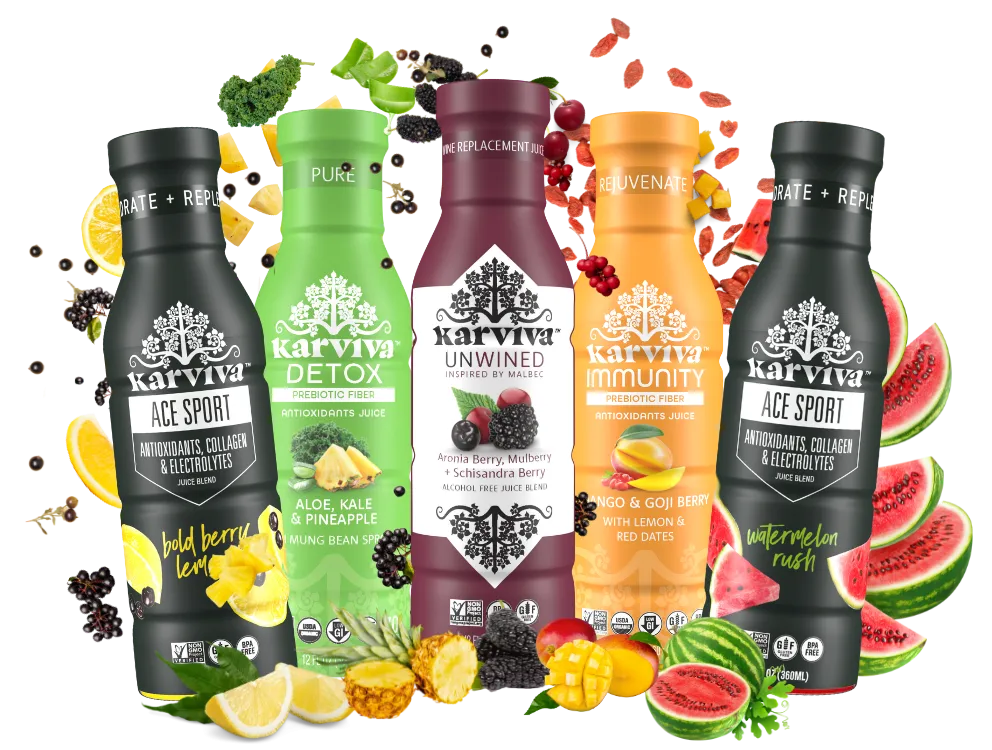
- Low in added sugar. Blood sugar spikes from high-sugar juices drive cortisol and insulin responses that compete directly with detoxification. Karviva blends contain 5–8g of naturally occurring sugar per serving—a fraction of the 30–50g in most conventional juice cleanses.
- Well hydrated. Clean, filtered water throughout the day alongside any blends or broths. Hydration is one of your body’s primary excretion routes.
- Paired with rest. Detoxification requires real energy. Intense exercise during a cleanse competes for that energy rather than supporting it. Light walking, stretching, and good sleep are far more useful.
- Timed sensibly. In TCM, spring is the natural cleansing season—aligned with liver and Wood energy. Beginning a detox during a period of acute stress, illness recovery, or serious sleep deprivation is asking your body to run two demanding processes simultaneously.
The Karviva Approach in One Sentence
Support the body’s natural detoxification. Don’t try to force it.
In practice, that means blending instead of juicing so fiber stays intact. It means using herbs—schisandra, goji berry, ashitaba, ginseng, holy basil—that TCM has applied specifically to support liver function for centuries. It means enough calories to fuel the work, and low enough sugar that you’re not undermining it.
The Karviva Wellness Reset isn’t designed to deliver a dramatic before-and-after. It’s designed to do something more lasting: leave your detox pathways in better condition than they were before you started.
What’s Coming in Post 4
You now understand the mechanism most cleanse marketing doesn’t want to explain. Toxins released too quickly simply recirculate. The liver can only process so much per hour. The body protects you by holding what it can’t handle—until a rapid cleanse tells those fat cells to open up all at once.
But there’s one system this entire conversation depends on—the one most quietly responsible for whether your detox actually works or quietly fails in the background: the gut. Elimination.
In Post 4, I’ll explain why fiber is the unsung MVP of every effective detox, why a juice-only cleanse is structurally set up to underdeliver on elimination, and what a practical fiber strategy actually looks like.