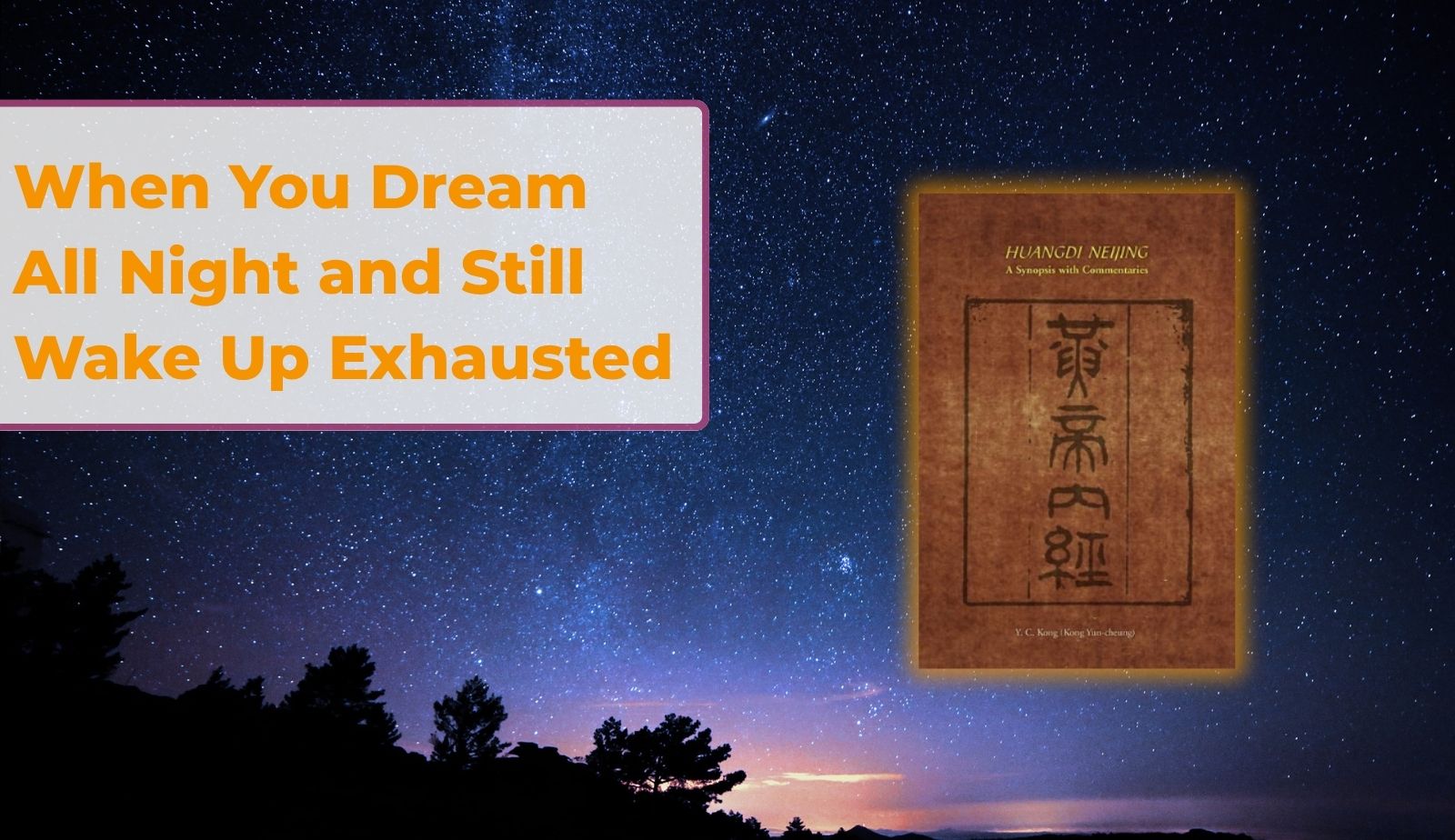





There is a chapter in the Huangdi Neijing, the foundational text of Chinese medicine, that is entirely about dreams.
Not as omens. Not as messages from ancestors. As clinical information. The chapter is Ling Shu 43, 淫邪发梦 (Yín Xié Fā Mèng), usually rendered as something like “Pathogenic Excess Generating Dreams,” and it reads like a diagnostic table. This state of the body produces this kind of dream. That state produces that kind.
It was written down roughly two thousand years ago by physicians who could not measure a single thing we can measure now. They had no EEG, no polysomnography, no way to see REM sleep. What they had was an enormous number of patients, careful listening, and centuries of accumulated notes.
I grew up in a family rooted in both Chinese and Indonesian traditions, where dreams were taken seriously as information about the body and not only about the psyche. It took me a long time to go back and read what the classical texts actually say, rather than what the wellness internet says they say. The real thing is stranger, more specific, and in some ways more interesting.
Let me show you it properly, and then be honest about what to do with it.
The Mechanism the Chapter Proposes
The chapter opens with a theory before it gets to the list, which I’ve always liked. Something enters the body from outside, finds no fixed place to lodge, spills into the organs, travels with the circulation, and – the phrase is the memorable one – 与魂魄飞扬, causes the Hun and Po to fly and scatter. The person lies down unsettled and dreams a great deal.
That’s the whole model in one sentence. Dreams proliferate when something in the system has no place to settle.
It’s the same logic behind excessive dreaming in the last article: the spirit needs an anchor, and unanchored is the problem state. What the dream chapter adds is that the content was thought to tell you where the disturbance sat.
The Twelve Excesses
The chapter is organized in two halves, which almost nobody who quotes it mentions. First, twelve states of excess (盛, shèng), which the text says to treat by draining. Then fifteen states of insufficiency (不足, bù zú), treated by tonifying.
The twelve excesses:
| State | Dream |
| Yin qi in excess (阴气盛) | Wading through great water, in fear |
| Yang qi in excess (阳气盛) | A great fire, burning and scorching |
| Both Yin and Yang in excess | Mutual killing |
| Excess above (上盛) | Flying |
| Excess below (下盛) | Falling |
| Extreme hunger (甚饥) | Taking, seizing |
| Extreme fullness (甚饱) | Giving, handing over |
| Liver qi in excess (肝气盛) | Anger |
| Lung qi in excess (肺气盛) | Fear, weeping, soaring |
| Heart qi in excess (心气盛) | Much laughing, and dread |
| Spleen qi in excess (脾气盛) | Singing and music; the body heavy and impossible to lift |
| Kidney qi in excess (肾气盛) | The lumbar spine splitting in two, coming apart |
Read that list slowly and a few things jump out.
Flying and falling are about direction, not psychology. Excess above, you fly. Excess below, you fall. Two of the most universal dream experiences in the human species, and the Neijing reads them as a question of where in the body things have piled up.
Hunger and fullness show up explicitly. Very hungry, you dream of taking. Very full, you dream of giving. The text is plainly saying that the physical state of the digestive system on the night in question shapes the plot of the dream.
“The body heavy and impossible to lift.” Anyone who has had that dream where you cannot run, where your legs won’t answer, will recognize it instantly. The Neijing files it under the Spleen, the system governing transformation and the sense of physical substance and heaviness.
The Fifteen Insufficiencies
The second list works differently. Here a counterflow qi lodges in a place, and each location produces its own imagery:
Heart – hills, smoke and fire. Lung – soaring; strange objects of gold and iron. Liver – mountain forests and trees. Spleen – hills and great marshes, ruined houses, wind and rain. Kidney – standing at the edge of an abyss, submerged in water. Bladder – wandering and travelling. Stomach – eating and drinking. Large Intestine – open fields. Small Intestine – crowded towns and busy thoroughfares. Gallbladder – fighting and litigation, and self-disembowelment. Genitals – sexual intercourse. Neck – beheading. Lower legs – walking but unable to go forward. Thighs and upper arms – bowing and rising in ritual. The bladder region (胞) – urinating and defecating.
That last one should stop you, because it’s checkable against your own life. The Neijing files dreams of urinating and defecating under a disturbance in the bladder region. Every person reading this has had that dream, usually the one where you finally find a bathroom and something is wrong with it, and has woken up needing to go.
The classical mechanism isn’t ours. But the observation underneath it – that the bladder writes itself into the plot – is one anybody can verify, and somebody wrote it down two thousand years ago.
A third list, in Su Wen 80, covers organ deficiency and adds seasonal variants: Kidney deficiency produces dreams of boats and drowning people, and in winter, of lying submerged in water. Lung deficiency, white objects and scenes of bloodshed; in autumn, battles. Heart deficiency, fighting fires. Spleen deficiency, not having enough to eat, and in late summer, building walls and roofing a house.
I find that last one oddly touching. A depleted digestive system dreams of construction – of building the shelter it can’t currently provide.
What I Think This Is Actually Worth
Here is where I want to be very clear, because this material gets abused.
A dream is not a diagnosis. If you dream about water, you do not have a Kidney problem. There is no study validating these mappings, no clinical trial, and nothing resembling a controlled test. Any practitioner or website telling you what your organs are doing based on your dream content is making a claim the evidence does not support, and I’d be cautious about anyone selling on that basis.
The classical system itself is less tidy than it looks. When researchers reviewed how Chinese medicine actually classifies insomnia across 103 studies and 9,499 patients, they found 69 distinct patterns in use, with overlapping symptoms and inconsistent terminology. And the lists themselves aren’t identical: a parallel passage in Su Wen 17 keeps the hunger and fullness pairing but covers only the Liver and Lung among the organs, dropping Heart, Spleen and Kidney entirely, and it adds two lines about intestinal parasites that I have never once heard anyone quote.
So what’s it good for?
The underlying claim is the valuable one, and it’s correct. The Neijing’s real assertion is not “water means kidneys.” It is that the body’s physical state on a given night participates in what you dream. Hunger, fullness, a full bladder, heat, cold, pain, position, the direction of pressure. Modern sleep research supports this narrower claim comfortably – external stimuli and bodily sensations get woven into dream narratives, and the bladder example is something almost everyone has personally verified.
That’s a genuinely useful idea, and it’s the opposite of how most people think about dreams. We treat them as purely psychological. The Neijing insists they’re also physiological. Both are true, and only one of them is currently fashionable.
And it reframes what a dream journal is for. Most dream journaling asks what a dream means. The Neijing’s question is better: what was my body doing last night? Recurring dreams of being unable to move, in someone who is exhausted by day. Recurring anger dreams, in someone waking at 2am in the Liver’s window on the organ clock, grinding their teeth about work. Recurring dreams of heat, in someone in perimenopause.
Those are not diagnoses. They are patterns worth noticing, and they connect the night to the day in a way that usually turns out to be informative.
One Dream I Do Take Seriously
I’ll give you the example that convinced me this framework has something in it.
In the tradition, recurring dreams of water and oceans in a new mother are read as overwhelm and a shifting sense of self, and as a signal that the system needs support rather than more effort. You can be entirely sceptical of the organ correspondence and still notice that this reading is clinically excellent. It takes a common experience, treats it as meaningful information rather than something to be dismissed, and points toward support instead of blame.
That, to me, is what the classical framework is really offering. Not a decoder ring. A habit of taking the body’s night-time signals seriously and asking what they’re responding to.
Postpartum mood changes deserve real care, and if that’s where you are, please talk to your doctor. But a tradition that noticed the pattern two thousand years ago and interpreted it as a call for nourishment rather than a personal failing was, I think, ahead of where a lot of modern culture still is.
How to Use Any of This
- Keep the journal, change the question. One line each morning about the dream, and one line about the body: what you ate, what time, how the day went, whether you woke in the night. The pairing is where anything useful shows up.
- Look for repeats, ignore one-offs. A single strange dream is noise. The same dream three weeks running, alongside the same daytime state, is a pattern.
- Check the obvious physical explanations first. Late meal, alcohol, a hot room, an uncomfortable position, a full bladder, illness, a new medication. The Neijing would have looked here first too.
- Notice the timing as well as the content. Consistently waking in the same window most nights is more informative than what the dream was about.
- Don’t self-diagnose from a dream. And do get medical advice for persistent distressing dreams, unrefreshing sleep, or any dream you physically act out.
- Do the boring things first. Remembering them at all requires a full night and a gentle waking. Everything in this article depends on that.
Where Karviva Fits In
Karviva was built on the idea that a lot of what modern wellness treats as separate – mood, digestion, sleep, energy – was understood in Traditional Eastern wellness as one connected system. The dream chapter is a nice illustration of that. It never occurred to those physicians that a dream would be filed under psychology and a stomach ache under medicine. Same person, same night, same body.
That’s the thinking behind the whole-plant approach in the Karviva Wellness Reset and the rest of the line: work with the whole system rather than isolating a single nutrient and hoping. It’s the same principle behind the Seven Nourishments framework I’ve written about before. Nourishment over depletion, working with human biology rather than against it.
Your dreams are not a diagnostic report. But they are one of the few places where the body reports on itself unprompted and without editing, and the physicians who wrote that chapter were paying closer attention than most of us do.
Part 7 is the practical one: what the evidence actually says about food, herbs, and the second half of the night, including which popular sleep foods are better supported than others.