




For most of my life, I was trained to look outward for answers.
As a scientist and pathologist, I learned to trust data, measurements, lab results, and clinical evidence. That training shaped how I saw the world—and for a long time, I genuinely believed it was the complete picture.
But my first teacher wasn’t a laboratory.
It was my grandfather.
He was a Traditional Chinese Medicine herbalist, and from the time I was small, I watched him listen to people in a way that Western medicine rarely teaches. He didn’t just ask what hurt. He asked how people slept, what they craved, how their energy moved through the day. He paid attention to the whole person—not just the symptom in front of him.
That stayed with me, even as I built a career in science. And eventually, it called me back.
Leaving medicine to start a wellness beverage company was not the safe choice. People thought I was walking away from everything I had worked for. In some ways, I was. But I was also walking toward something I had always known, somewhere underneath all the training:
Our bodies are constantly communicating with us.
The challenge isn’t that the wisdom isn’t there. The challenge is that most of us have forgotten how to hear it.
Your Body Was Designed to Heal
One of the biggest misconceptions in modern wellness is the idea that health is something we have to manufacture—that there’s always one more supplement, one more program, one more expert who has the answer we’re missing.
But look at nature for a moment.
A cut heals on its own. A broken bone knits itself back together. The body detoxifies, regenerates, and adapts without us consciously directing any of it.
In Traditional Chinese Medicine, health isn’t something we force into existence. It emerges when we create the right conditions—when we stop fighting the body and start supporting it instead.
This was what my grandfather understood intuitively, and what I’ve come to understand through a combination of science and lived experience: the body isn’t the problem to be solved. It’s the intelligence we need to work with.
The Signals We’ve Stopped Hearing
Most people know when they’re hungry. But many have lost the ability to tell when they’re actually nourished.
Most people know when they’re tired. But many override that signal with a second coffee, a third, a fourth.
Most people know when they’re stressed. But many have lived with chronic stress for so long that they’ve started to mistake it for normal.
Our bodies speak to us constantly—through energy levels, digestion, sleep quality, mood, cravings, skin, hormonal patterns, even breath. These aren’t inconveniences or random glitches. They’re messages.
In TCM, symptoms are often seen as information before they become disease. The body tends to whisper for a long time before it starts to shout.
Why Ancient Traditions Still Matter
Traditional Chinese Medicine developed over thousands of years of careful observation, long before anyone had a laboratory or a clinical trial to reference.
Practitioners paid close attention to patterns: How did people feel after certain foods? How did changing seasons affect health? What happened when emotions went unaddressed for months? What changed when people rested more, or moved differently?
Modern science has since explained many of the mechanisms behind these observations. But the original discoveries started with something deceptively simple—people paying attention, and taking what they noticed seriously.
The wisdom wasn’t hidden in a formula. It was passed from practitioner to patient, from teacher to student, from grandfather to grandchild, over generations. In my case, quite literally.
The Lost Art of Trusting Yourself
Many of us have become so disconnected from our own signals that we look outside ourselves before we look within. We ask:
- What diet should I follow?
- What supplement is right for me?
- What’s the wellness trend everyone’s talking about?
When a far more direct question might be:
What is my body actually trying to tell me right now?
The answer will be different for every person. One person needs more rest. Another needs more movement. Someone else needs more genuine human connection—or simply permission to slow down without guilt.
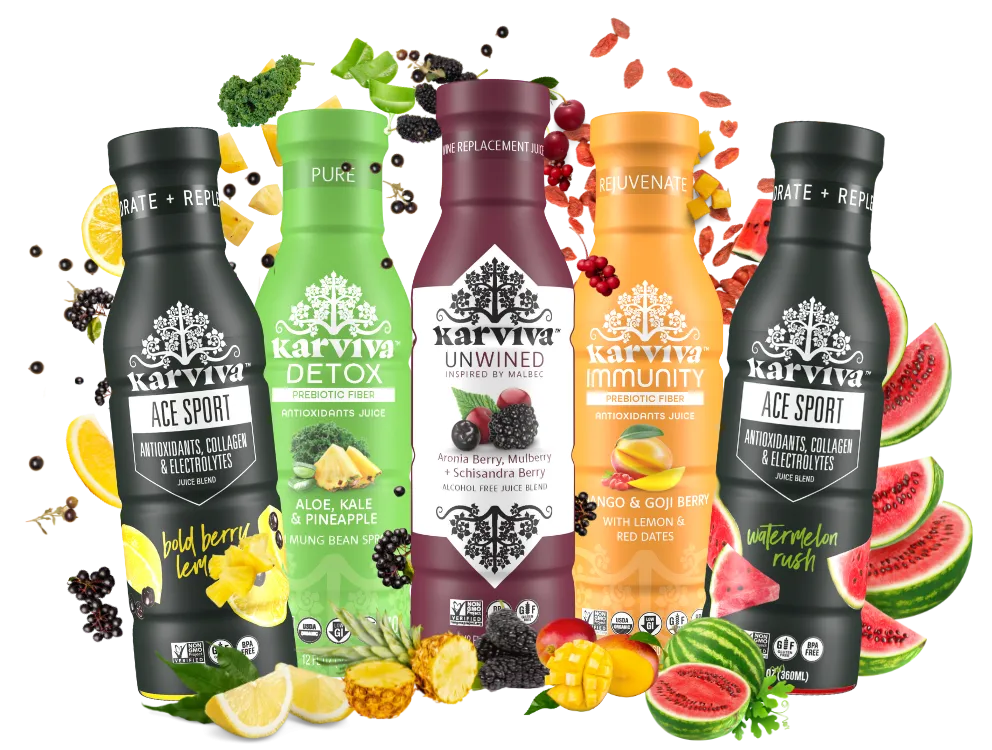
I think about this every time I’m developing a new Karviva product. The question I keep returning to isn’t “what’s trending?” It’s “what does the body actually need—and what did our ancestors already know about giving it that?”
Real wellness was never one-size-fits-all. It never has been.
What Joy Has to Do With Health
Here’s something I think gets left out of most wellness conversations:
Joy is not a luxury. Joy is medicine.
I went through a period in my life where everything looked fine on paper—career momentum, accomplishments ticking along, all the visible markers of success. But I was running on empty. I had optimised almost everything except the things that actually made me feel alive: real connection, laughter, the quiet satisfaction of building something meaningful.
When I finally slowed down enough to pay attention to what my body was telling me, it wasn’t asking for a different supplement. It was asking for a different relationship with life.
In Traditional Chinese Medicine, emotions and physical health have never been treated as separate systems. Modern research is increasingly confirming what ancient traditions already understood: joy, connection, purpose, and belonging aren’t just nice to have. They’re biological necessities. They affect your hormones, your gut, your immune system, your ability to sleep.
Healing isn’t just the absence of disease. It’s the presence of vitality. And in my experience, vitality tends to follow joy—not the other way around.
What Joy Has to Do With Health
Here’s something I think gets left out of most wellness conversations:
Joy is not a luxury. Joy is medicine.
I went through a period in my life where everything looked fine on paper—career momentum, accomplishments ticking along, all the visible markers of success. But I was running on empty. I had optimised almost everything except the things that actually made me feel alive: real connection, laughter, the quiet satisfaction of building something meaningful.
When I finally slowed down enough to pay attention to what my body was telling me, it wasn’t asking for a different supplement. It was asking for a different relationship with life.
In Traditional Chinese Medicine, emotions and physical health have never been treated as separate systems. Modern research is increasingly confirming what ancient traditions already understood: joy, connection, purpose, and belonging aren’t just nice to have. They’re biological necessities. They affect your hormones, your gut, your immune system, your ability to sleep.
Healing isn’t just the absence of disease. It’s the presence of vitality. And in my experience, vitality tends to follow joy—not the other way around.
The Wisdom Was Never Lost
Perhaps the most important thing I’ve learned—from science, from Traditional Chinese Medicine, and from the messier parts of life—is that healing is often less about learning something new and more about remembering something old.
My grandfather knew it. Generations of practitioners before him knew it.
And somewhere underneath the noise, I think you know it too.
The wisdom is already there. The body already knows.
Sometimes all we have to do is become quiet enough to hear it.